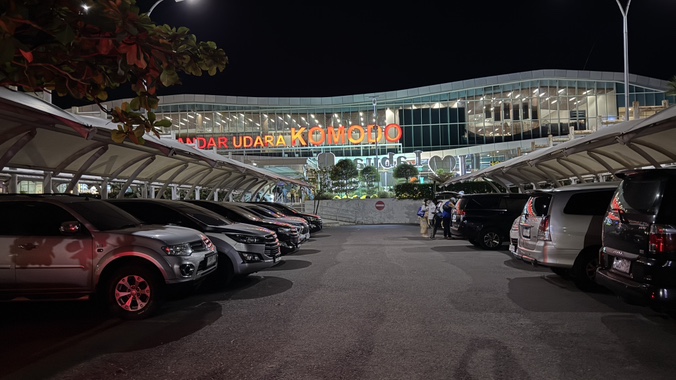
After Ubud, we flew from Bali to Labuan Bajo at the western end of Flores. Although the airport is called Komodo International, the national park is not a single island beside the runway. It is a network of islands and surrounding waters, including Komodo, Rinca and Padar. We had come to see the famous dragons, but the sea would become just as important to the story.
The flight was short. We had found an inexpensive first-class fare and booked it without expecting much from an Indonesian domestic route. The roomy seats, welcome drinks and meal were a pleasant surprise. Outside the window, Bali’s bustle gave way to hills, a broad bay and islands scattered across the water.
A night near the airport, then a boat of our own
Because our boat would leave the next morning, we stayed near the airport at Crowne Plaza rather than going into town. A car was waiting just for us. At the hotel we were welcomed with hot towels and a warm ginger drink, then settled into two quiet rooms. The generous breakfast the next morning continued a pattern we had begun to enjoy in Indonesia: local dishes alongside fruit, bread and eggs. Across the hotels, restaurants and, later, the ship, we were struck by how readily staff helped us.
Around ten, the boat company collected us. Two other groups were already in the vehicle: a couple from Texas with three children, and an Australian doctor of Indian heritage traveling with his Indonesian girlfriend. With our family of three, those were all the guests on this three-day, two-night voyage. At Labuan Bajo harbor we checked in, boarded small tenders and motored out to the larger vessel waiting offshore.
Our home was LaMaIn Voyage 2, a wooden boat built in the style of an Indonesian phinisi. It had eight ensuite cabins, two tenders and a crew of thirteen. We had booked two cabins on the upper deck, both larger than expected, with air conditioning, desks, private balconies and open sea views; one balcony even had a Jacuzzi. Because the larger boat could not enter shallow coves or pull up to many beaches, we would use the tenders for landings and snorkeling.
At the time of our booking, the top Master Cabin cost 17.5 million Indonesian rupiah per person and the upper-deck Eiffel Room 16 million; the voyage’s cabin categories broadly ran from several hundred to a little over a thousand U.S. dollars per person. Meals, snacks, nonalcoholic drinks, activities, snorkeling gear, transfers, guides and photography services were included. These are the prices we paid or were quoted for this trip, not current rates. The crew introduced themselves—captain, first officer, guide, photographer, service staff, tender drivers and engineers—before the first generous lunch appeared on the table. With ten guests aboard, the boat felt like a small floating hotel.
The first island and an evening full of wings
Our first landing was Kelor Island. The hill above its beach was short but steep. From the top, we could see white sand, bands of turquoise and deep-blue water, our boat offshore and rounded islands fading into the distance. This was the moment we felt we had entered the archipelago.
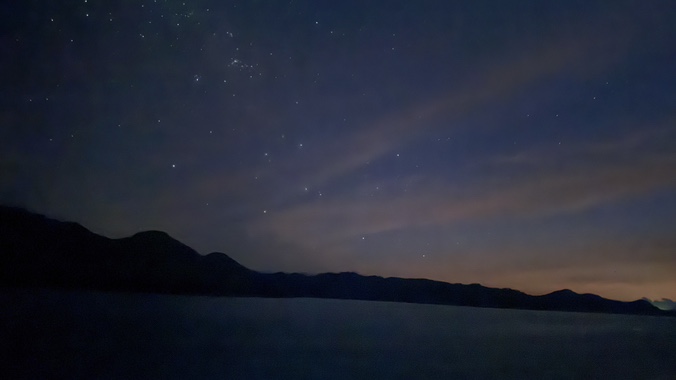
Near sunset we anchored off Kalong Island, whose mangroves are home to large fruit bats. First a few dark shapes crossed the sky, then long streams of them rose from the trees and flew over the water. The sea turned copper in the fading light; the islands became silhouettes. After dinner, with the engines quiet and no city nearby, we climbed to the open deck. Stars covered the sky almost to the horizon. We sat together as a family for a long time, listening to the water against the hull. That unscheduled hour remains one of my clearest memories of the voyage.
Standing in the sea and meeting its wildlife
The next morning a tender took us to Taka Makassar, a shallow sandbank that appears to let you stand in the middle of the sea. Water barely covered our ankles in places; beyond the pale shallows it turned a deeper blue. The ship’s photographer captured us from angles that hid the edge of the sandbank, making it look as though we were standing on an endless mirror.
We snorkeled nearby. Coral and fish were visible even from the tender. In the water we found a sea turtle moving calmly above the reef. We followed at a respectful distance as it surfaced for air and slipped down again. Watching it in its own element was a quiet counterpoint to the morning’s posed photographs.
Then came Komodo Island. It is inhabited, not an empty wilderness set aside only for wildlife; along the way we saw houses, children and farm animals. The modest living conditions were a sharp contrast to the Bali resorts we had just left. Local residents share this landscape with animals that visitors travel half the world to see.
A park ranger led our group inland, carrying a long stick and repeatedly asking us to stay together and keep our distance. We eventually saw two large Komodo dragons resting close together, one almost on top of the other. They barely moved, but their heavy limbs, long tails and claws dispelled any thought that they were ordinary lizards. We photographed them only from the place the ranger allowed. The encounter lasted minutes; the strangeness of standing near those powerful animals lasted much longer.
That afternoon we stopped at Pink Beach. The sand was a gentle blush rather than the bright pink of edited travel photographs, its color coming from red fragments mixed among white grains. Hills rose behind us, clear blue-green water stretched ahead, and some of our group swam or snorkeled close to shore while others rested.
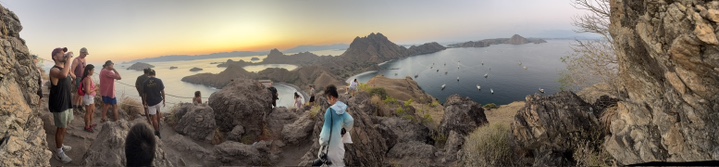
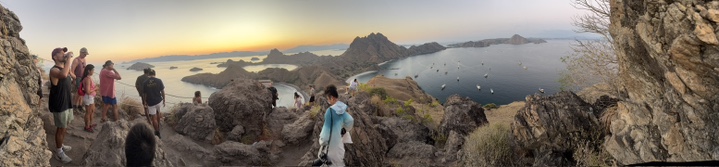
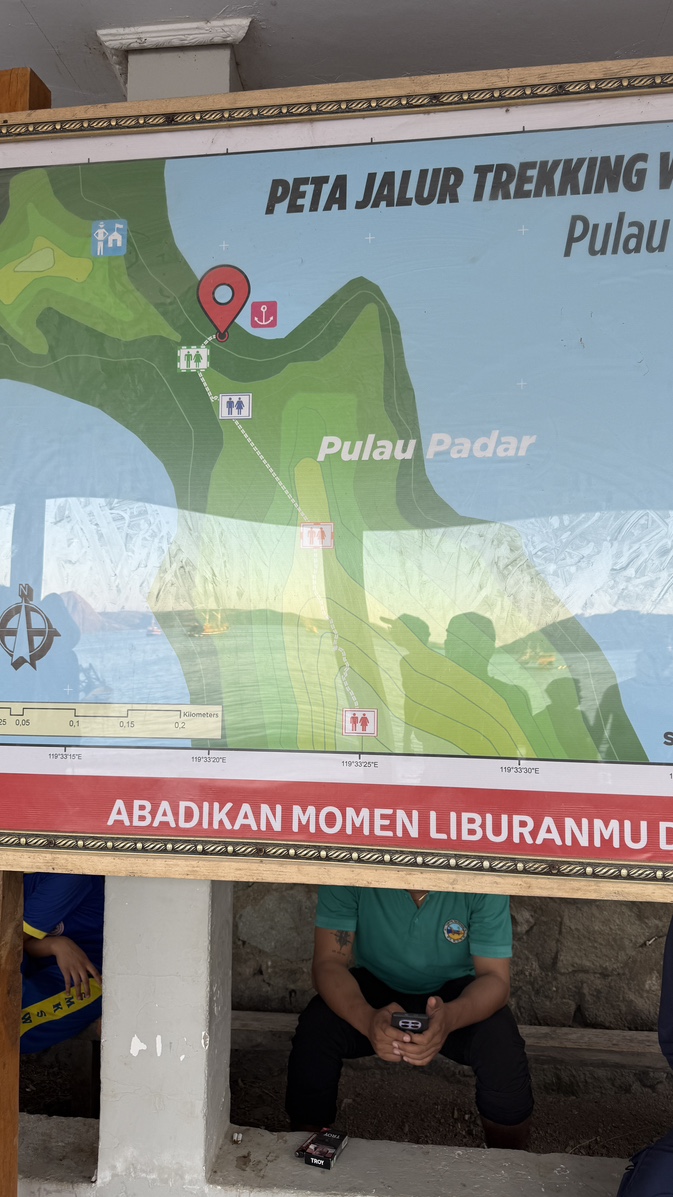
Near evening we climbed Padar Island. After a day of swimming, walking and sun, the stairs felt longer than they looked. The reward was the view of several bays curving into the island from different directions, with beaches and water in shifting shades of blue below the dry ridges. It was the iconic Komodo panorama, earned step by step.
What we found underwater
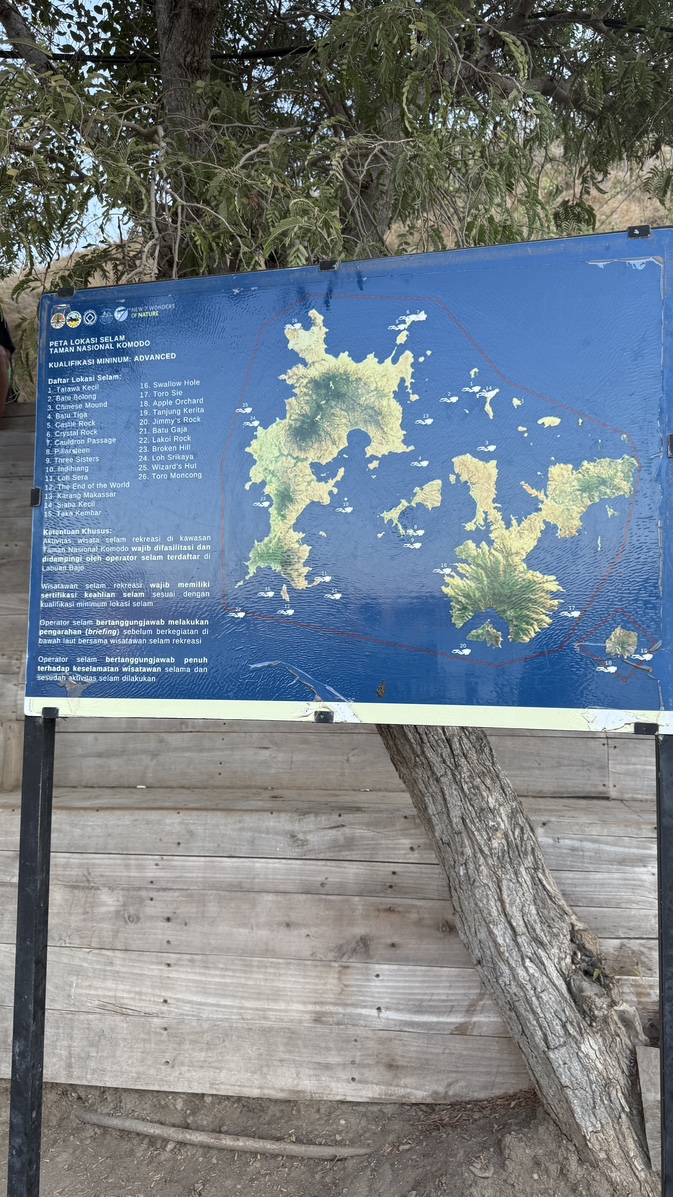
Across the three days, the crew took us to several snorkeling areas, including waters near Taka Makassar, Manta Point, Siaba Besar and Sebayur. The exact order changed with weather, tides and currents. We did not need every stop to match a printed itinerary; each cove had its own character. One had broad coral gardens, another dense schools of fish, another pale sand under exceptionally clear water. At one site a group of small fish seemed to swim toward us rather than away, sometimes bumping into us. It was funny and a little startling.
We had snorkeled before in Bora Bora, Hawaii and the Maldives. Each has its strengths—lagoons, turtles, volcanic terrain—but, of the places we had personally visited, Komodo had the richest combination of colorful coral and varied fish. The Australian doctor told us the Great Barrier Reef was even more spectacular; we could not compare from experience. We simply knew that every time we climbed back into the tender, we wanted another look.
Life aboard had its less glamorous side. Even small swells rocked the boat, and we took the seasickness medicine we had packed. The Australian doctor was hit much harder and became sick; the Texas family seemed untroubled. We learned to steady ourselves on a wall or rail while walking. In return for that inconvenience, each morning brought a different bay outside the cabin, meals overlooking passing islands, and evenings with the water close enough to hear.
On the final morning we snorkeled again near Sebayur before the crew served a last lunch. Labuan Bajo’s buildings slowly reappeared. We packed, transferred to the tenders and reached the harbor, where a vehicle took us straight to the airport. We had spent one night ashore and two aboard—four days and three nights from our departure from Bali to our return.
The dragons had drawn us here, but no single animal or beach defined the visit. It was the combination: a turtle above the reef, bats filling a sunset sky, the colors under the water, the dry islands sliding past our balcony, and a night of stars over a gently moving ship. Komodo felt more remote and elemental than the Bali we were returning to. The next evening would be our last in Indonesia.
Photo journal
Reader Discussion · 0
No comments yet. Be the first to share your experience.