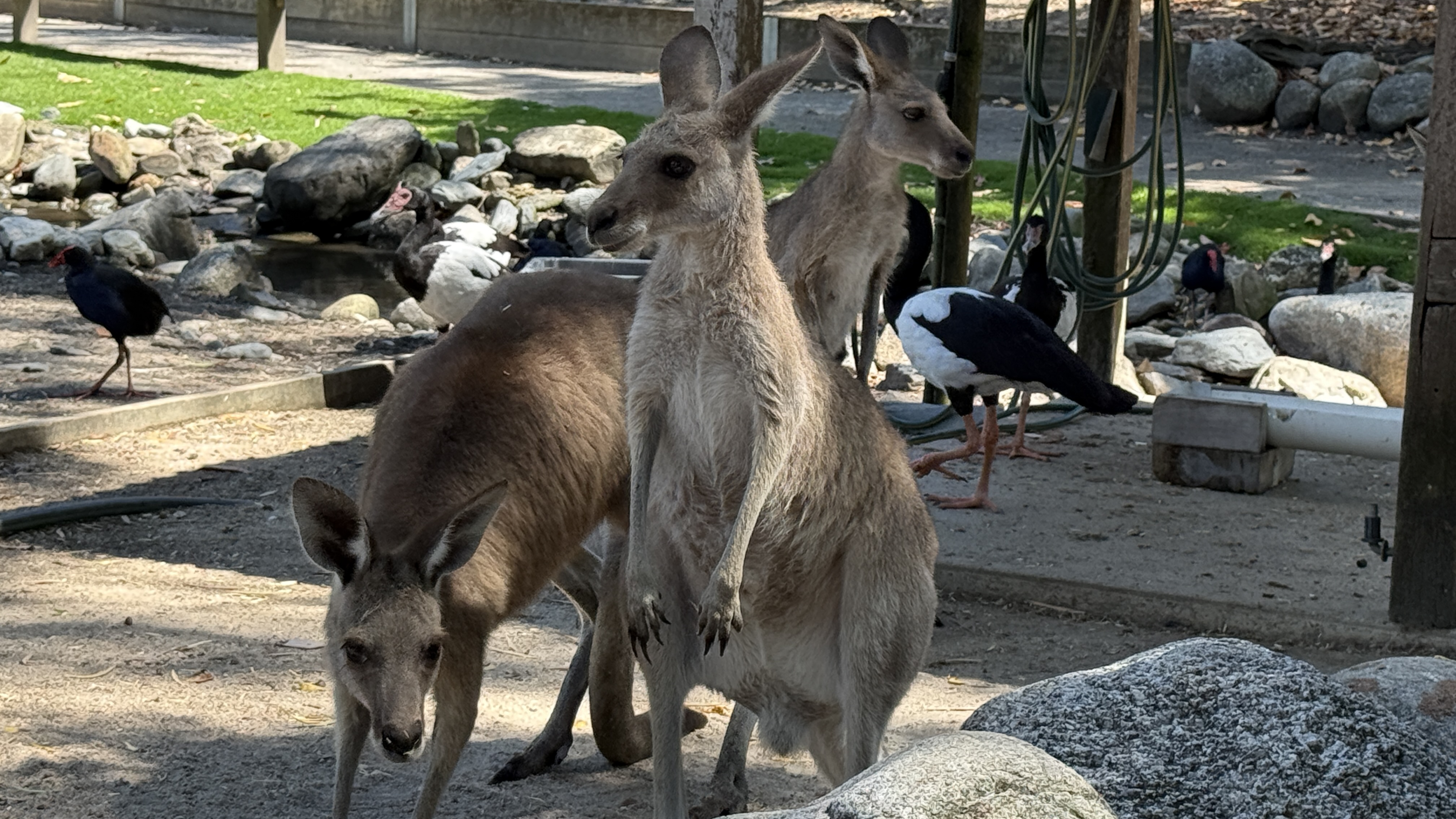
After flying more than ten hours from the United States, we finally reached Cairns. Jet lag hit harder than I expected. We were exhausted by six or seven in the evening and went to bed early, only to wake up around four the next morning. Since neither of us could fall back asleep, we decided to get an early start.
We had planned to watch the sunrise at Palm Cove, but by the time we had breakfast and packed up, the sun was already up. The beach was still lovely in the morning. There were few people on the long stretch of sand, though plenty of anglers stood along the jetty. Some had serious rods and gear; others sat back as if catching a fish would just be a bonus. The sea was blue in the distance, tall coconut palms lined the shore, and the air had that warm, humid feel of the tropics. We walked along the beach, took a few pictures, then drove north toward the place we were most excited to visit: Wildlife Habitat.
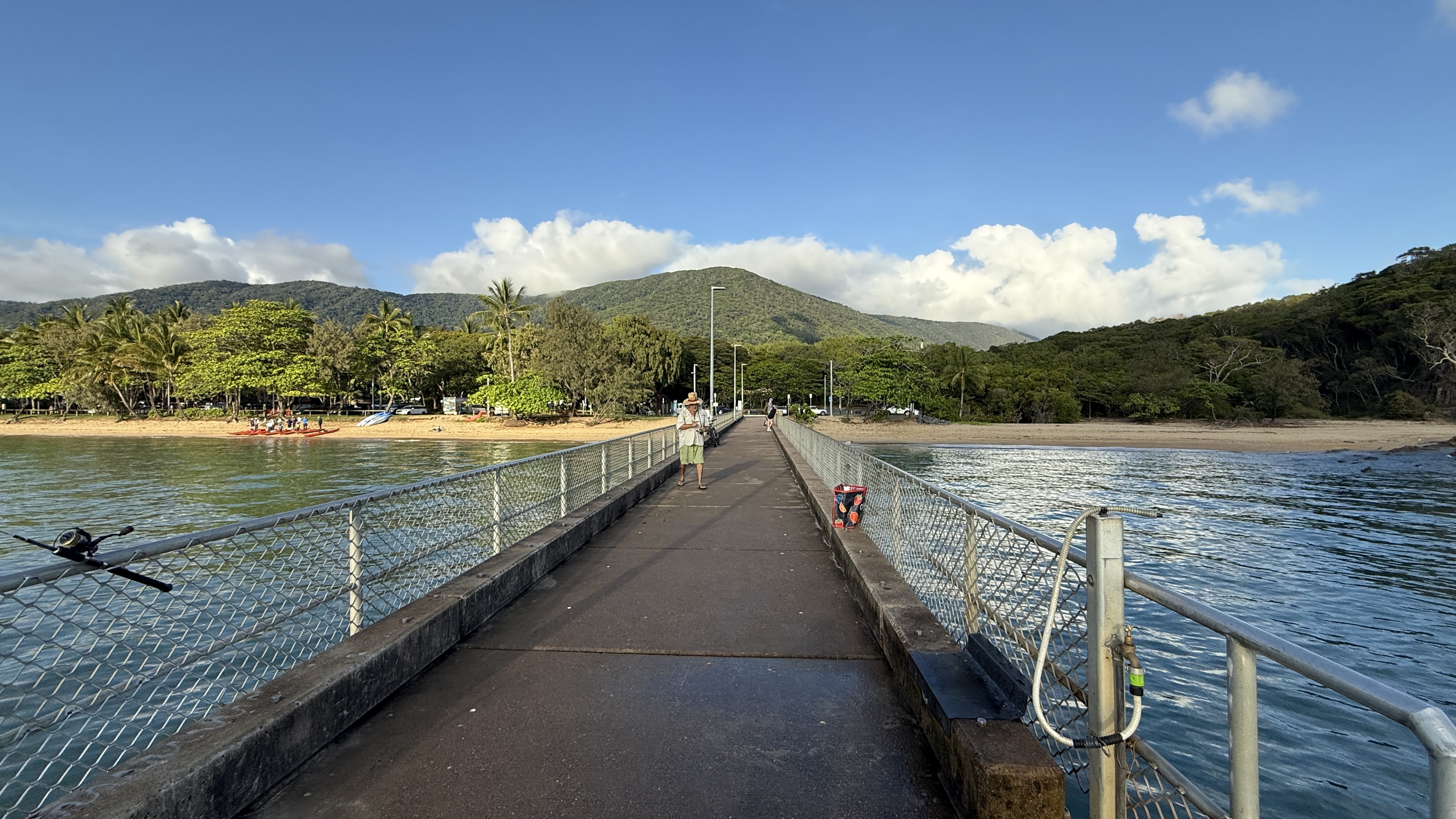
Wildlife Habitat: Kangaroos, Parrots and Fearless Animals
The drive from Palm Cove to Port Douglas takes about 45 to 50 minutes. Captain Cook Highway is a beautiful coastal road, with the blue Coral Sea on one side and rainforest-covered hills on the other. There are bays along the way that make you want to pull over for a photo. The road also has plenty of winding turns, and Australians drive on the left, so coming from the United States I had to concentrate instead of just admiring the view. Traffic was light that morning, and we reached Wildlife Habitat around eight, among the first visitors of the day.
Wildlife Habitat opened in 1989 as Rainforest Habitat. It is a wildlife park centered on native Australian animals. Instead of keeping many animals in traditional cages, the park gives them large, natural-looking habitats. Paths let visitors walk through those spaces. Birds fly overhead, and some may even land nearby. The park has rainforest, wetland, grassland and nocturnal habitats, with kangaroos, koalas, cassowaries, tree kangaroos, parrots, waterbirds, crocodiles, snakes and other Australian animals.
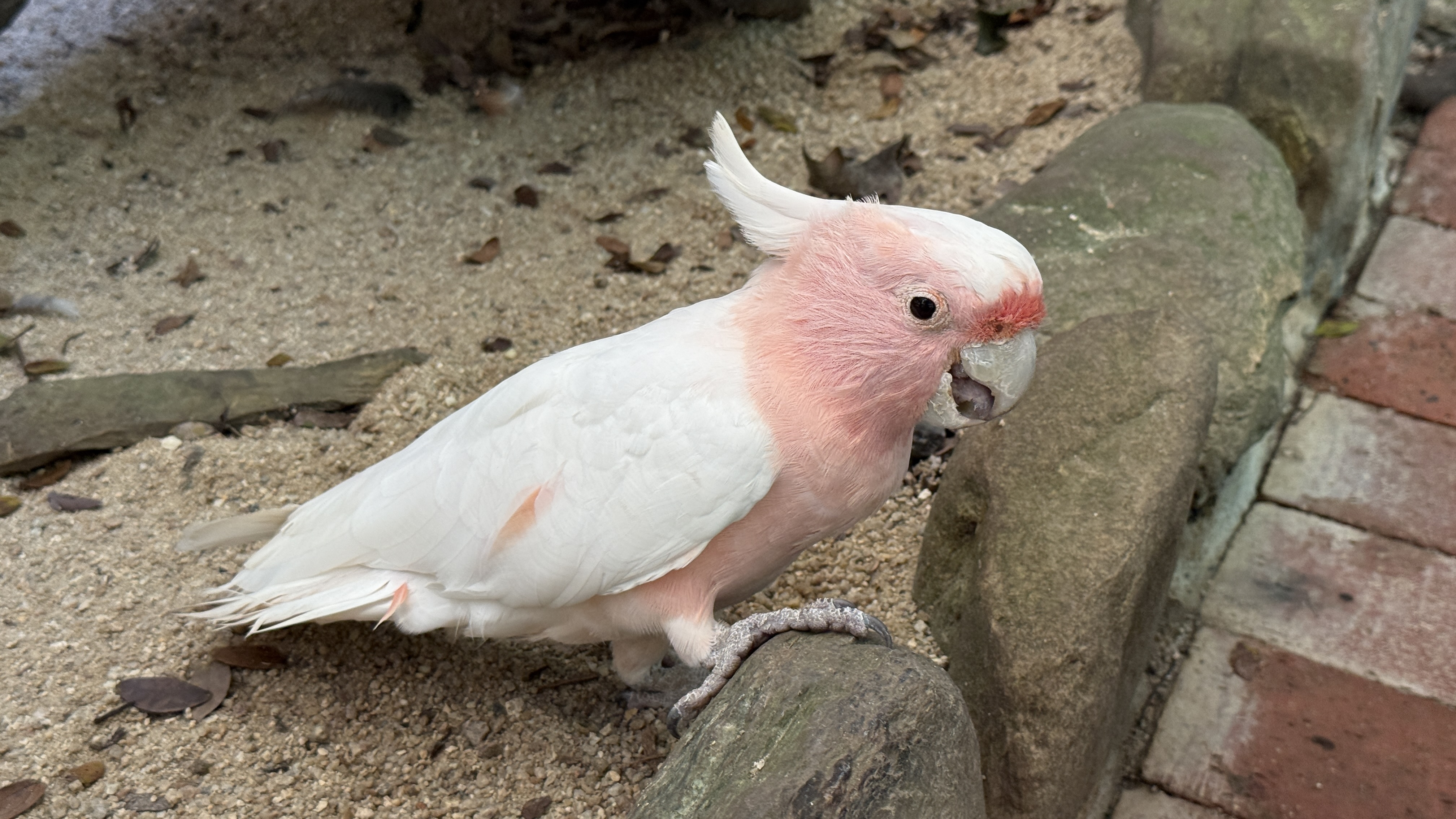
We have visited plenty of zoos in the United States, China and elsewhere, but this was our first time getting so close to so many animals. Zoos in the United States have petting areas, usually with farm animals such as sheep, goats and ponies. This felt completely different. Many of the animals walking around us were Australian wildlife we would normally see only behind glass or a fence.
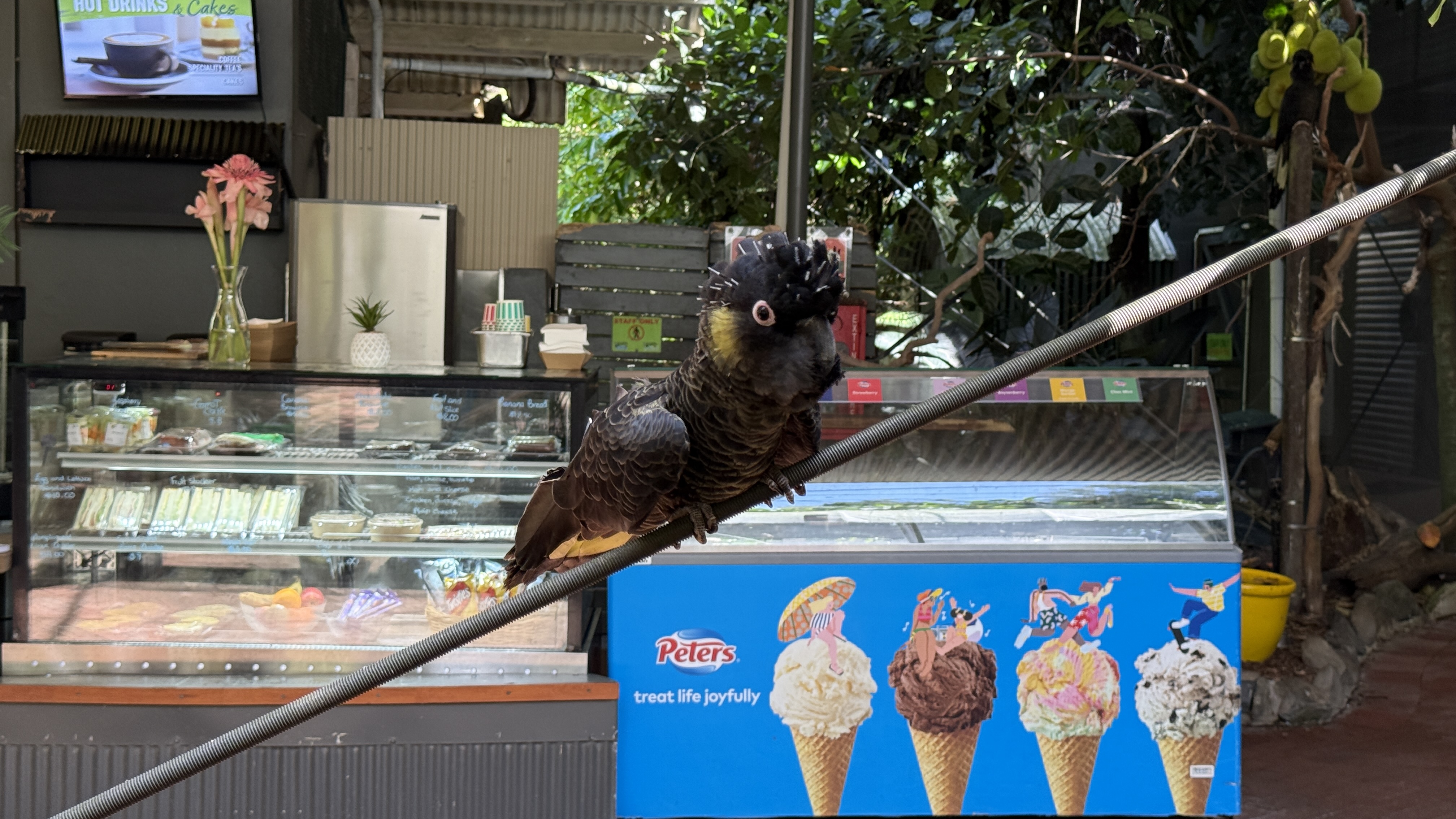
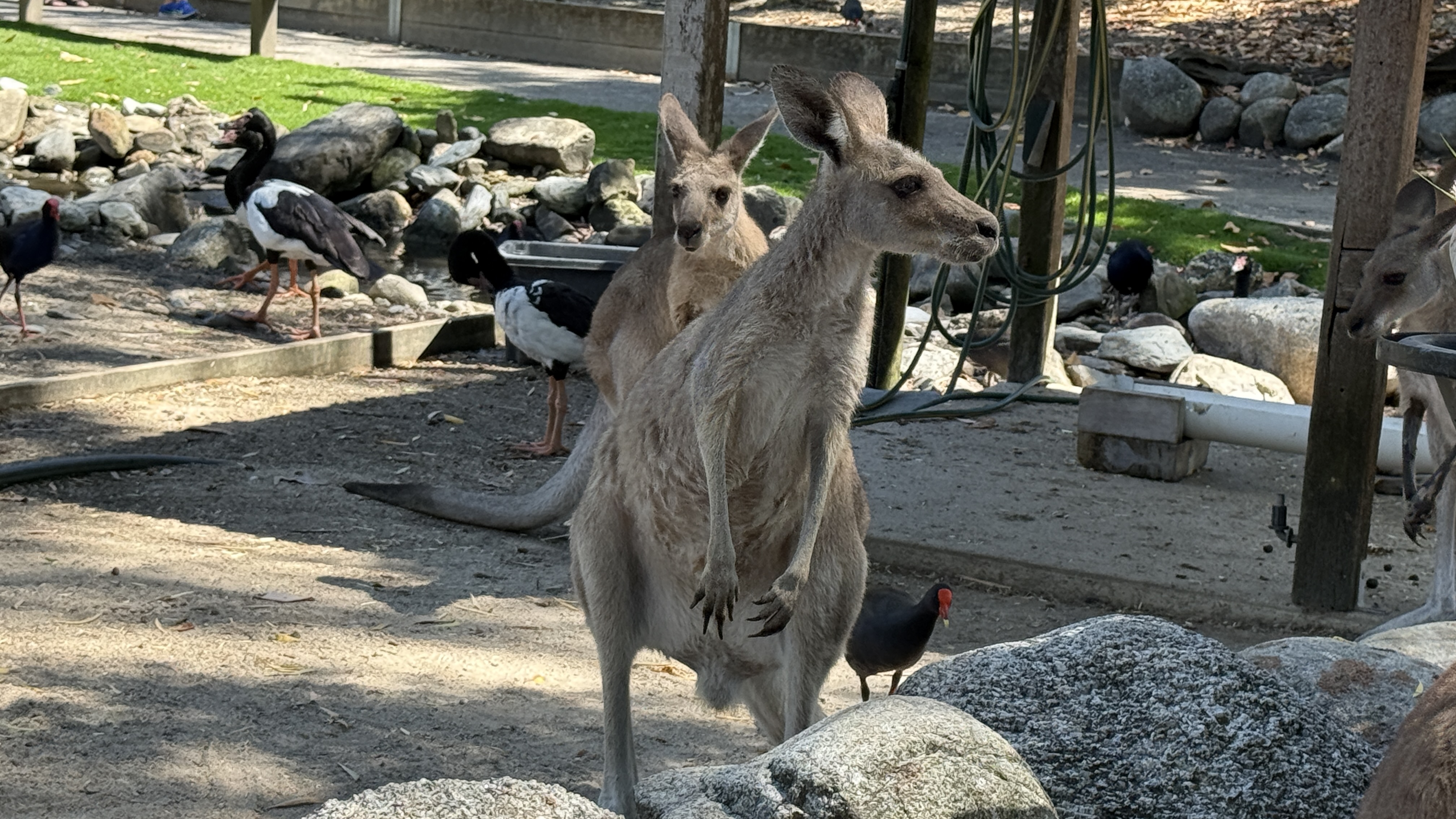
The kangaroos were the highlight. They were much less shy than I had imagined. When they saw visitors carrying the food provided by the park, some hopped over while others simply stood in front of us and waited for a handout. They took food gently from our palms, then looked up as if to ask, “Anything else?” Sometimes several gathered around at once, which was a lot of fun.
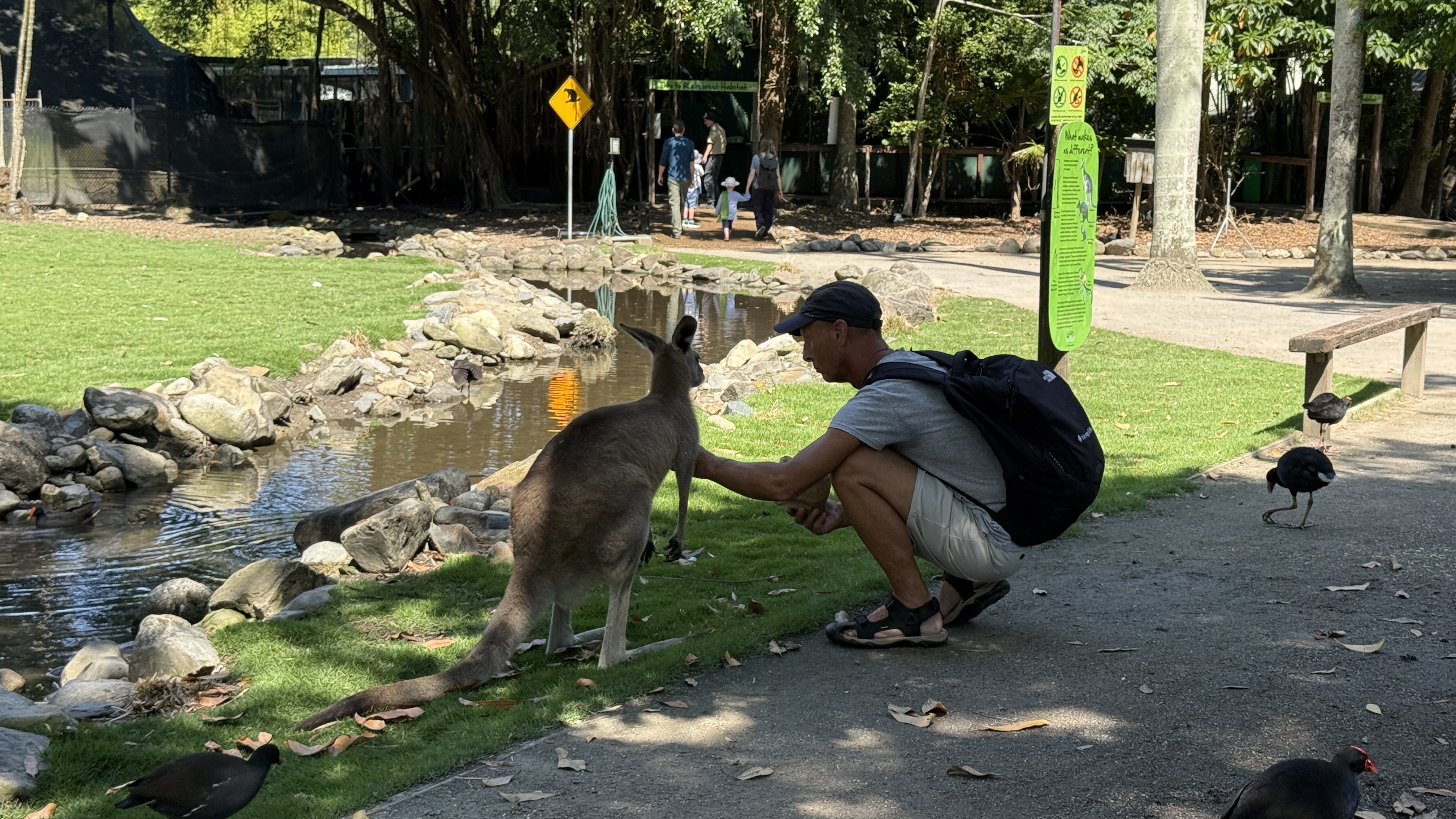
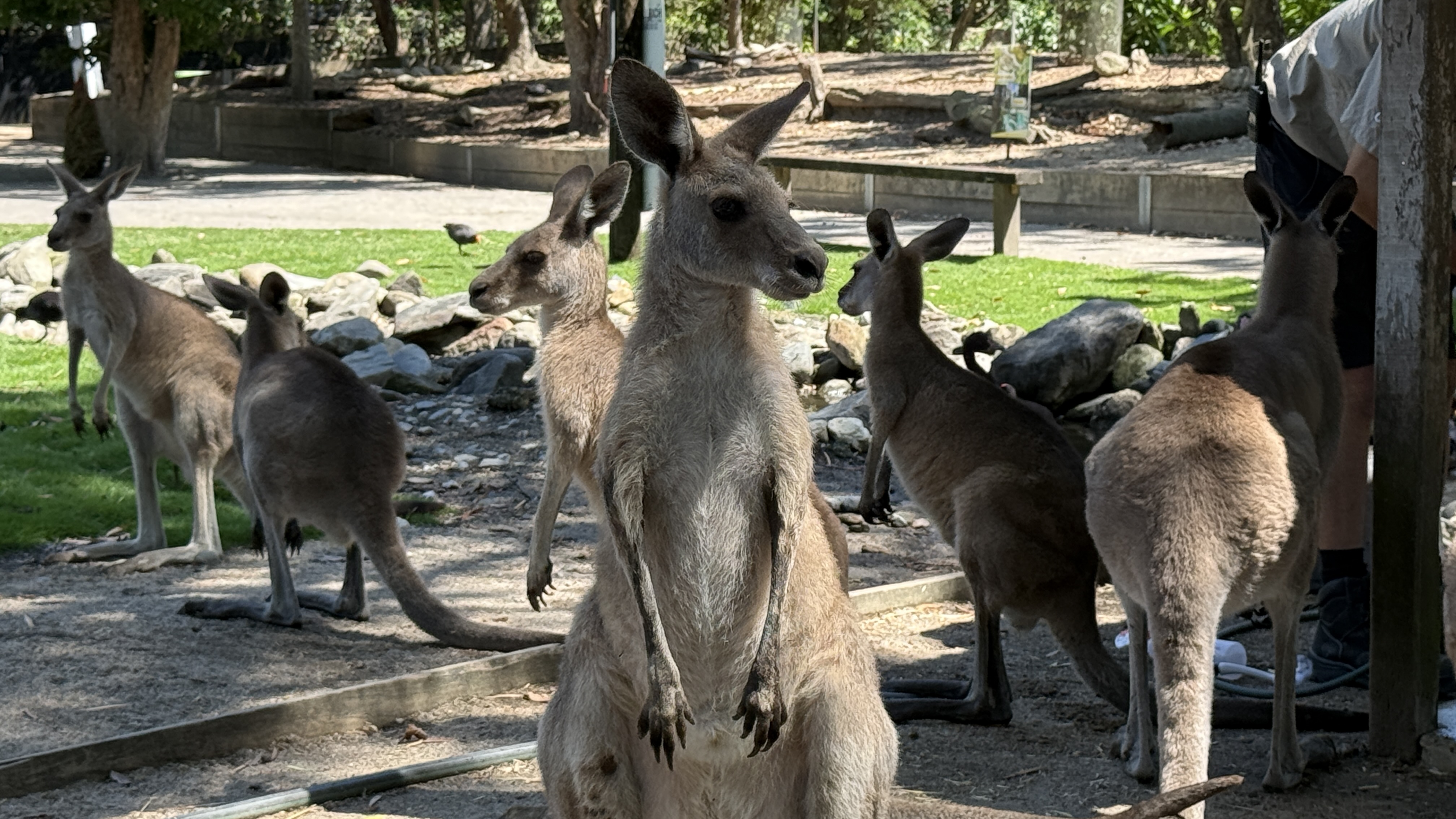
We also got a close look at their unusually long hind legs and thick tails. On television, a kangaroo’s hop seems ordinary enough. Standing beside one and watching it spring so far with such ease made the way it moved feel remarkable.
The parrots may have been even friendlier than the kangaroos. Some were like curious little kids, following visitors from place to place. One in particular kept coming over and calling “Hello! Hello!” as if it wanted to make sure we noticed.
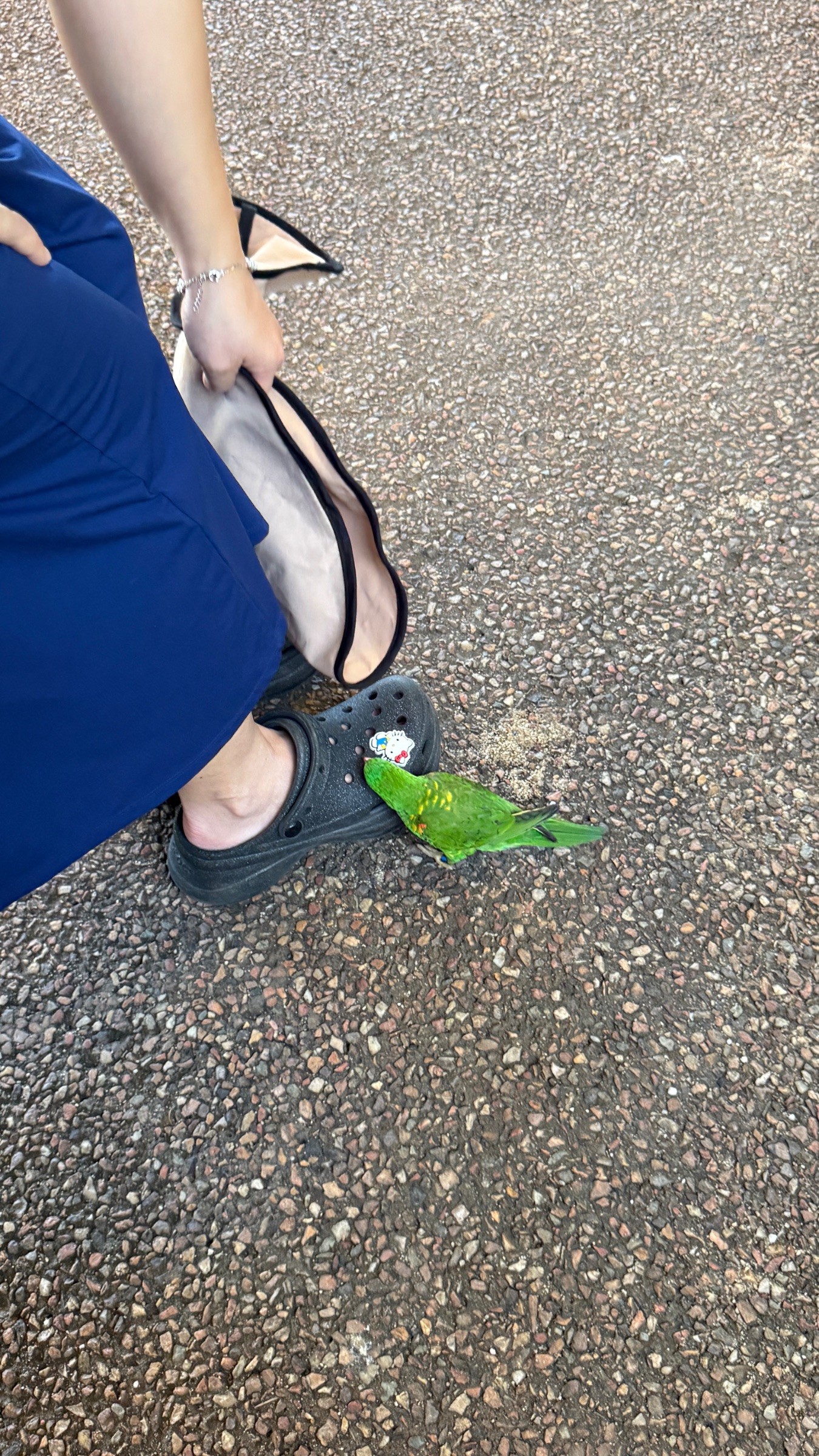
There were so many kinds of birds: some with feathers as bright as paint, some with unusual beaks, some quietly perched on branches and others weaving between visitors. We could stand just a step or two away and look closely; we did not even need a long lens for photos.
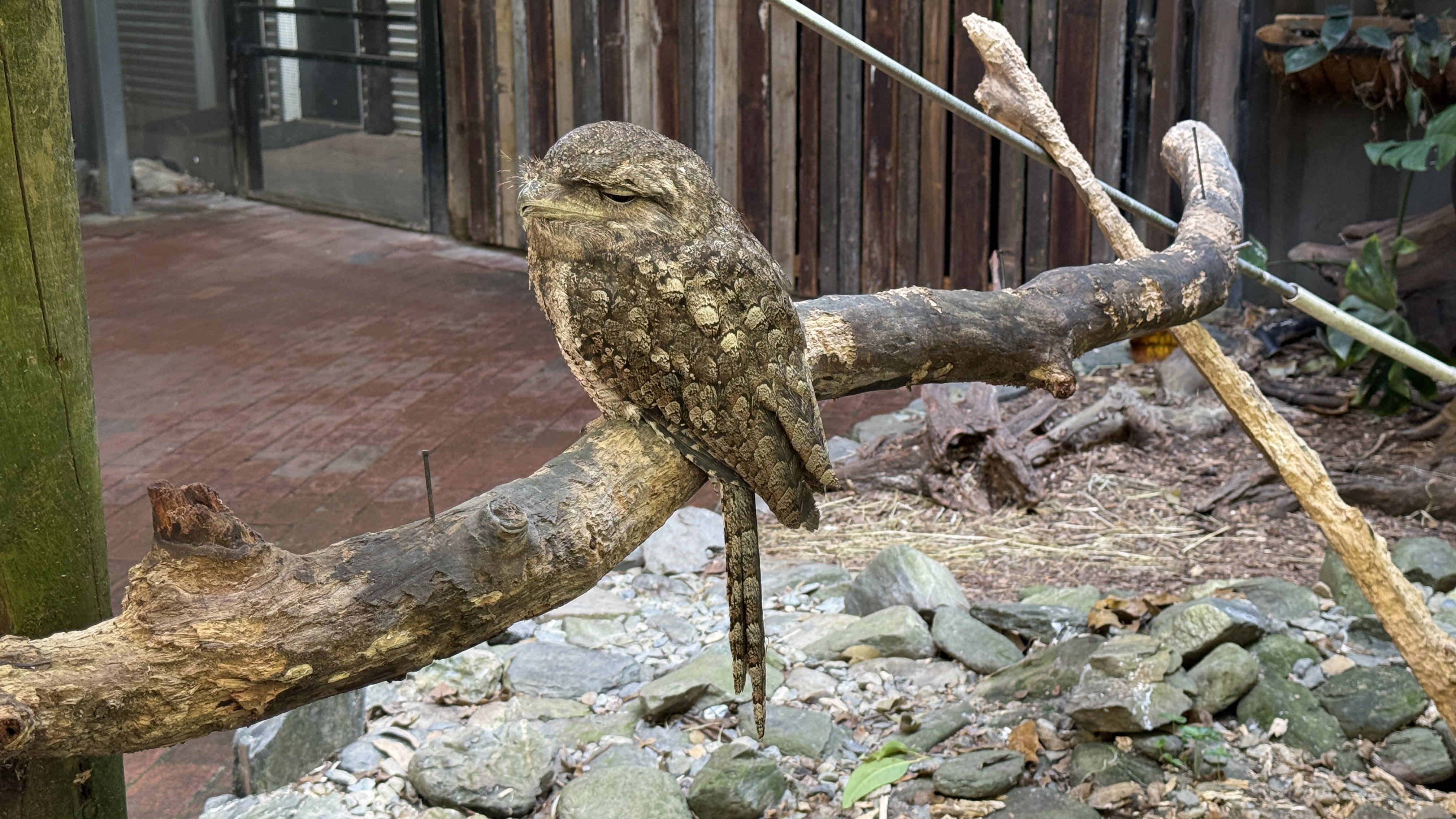
There were koalas, too, although we missed that day’s keeper talk. We were not too disappointed, since we had already booked a koala experience at Rainforestation Nature Park for the day after tomorrow, where Annie could hold one for a photo. For today, we focused on the other animals. The most astonishing was a huge bird that looked as if it had stepped out of the age of dinosaurs: the cassowary.
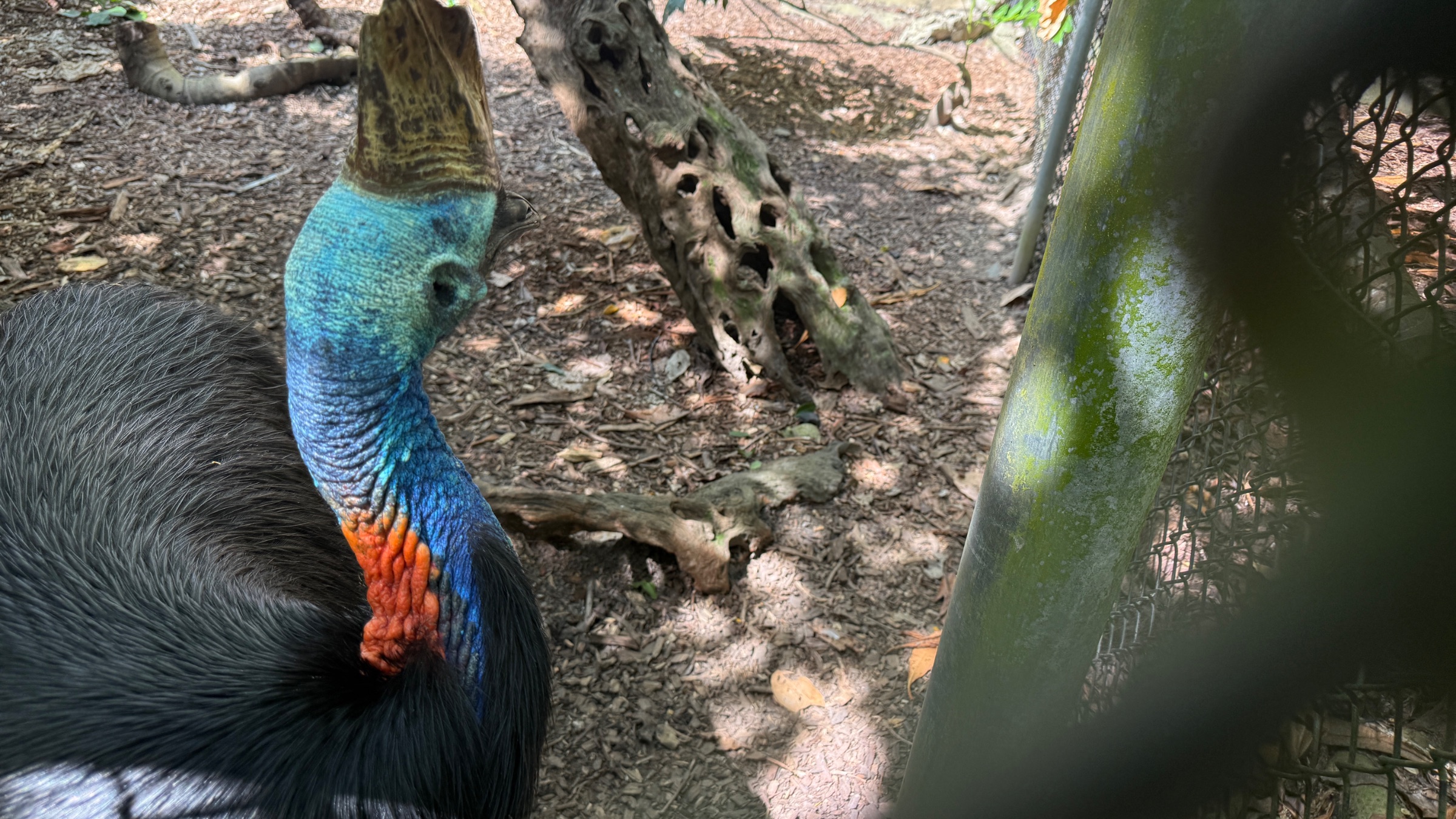
The cassowary is a rare, flightless bird found mainly in New Guinea and the tropical rainforests of northeastern Australia. In Australia, wild cassowaries live only in the northeast of Queensland, around the region we were visiting, and their numbers are low enough for them to be considered endangered. A staff member told us about two of their remarkable traits.
First, cassowaries can eat some rainforest fruits that are poisonous to people. Some of the blue fruits could make a person seriously ill, but cassowaries can eat them and help spread the seeds.
The second is the strange, hard structure on top of the bird’s head, called a casque. The staff member said it may help receive or carry low-frequency sounds, almost like a radio antenna, allowing cassowaries to sense calls from other birds through dense rainforest. He also gave ten kilometers as an example of how far their low calls might travel. Scientists are still studying what the casque does, and that distance has not been firmly established. Even so, it was fascinating to imagine a flightless bird with such an unusual feature.
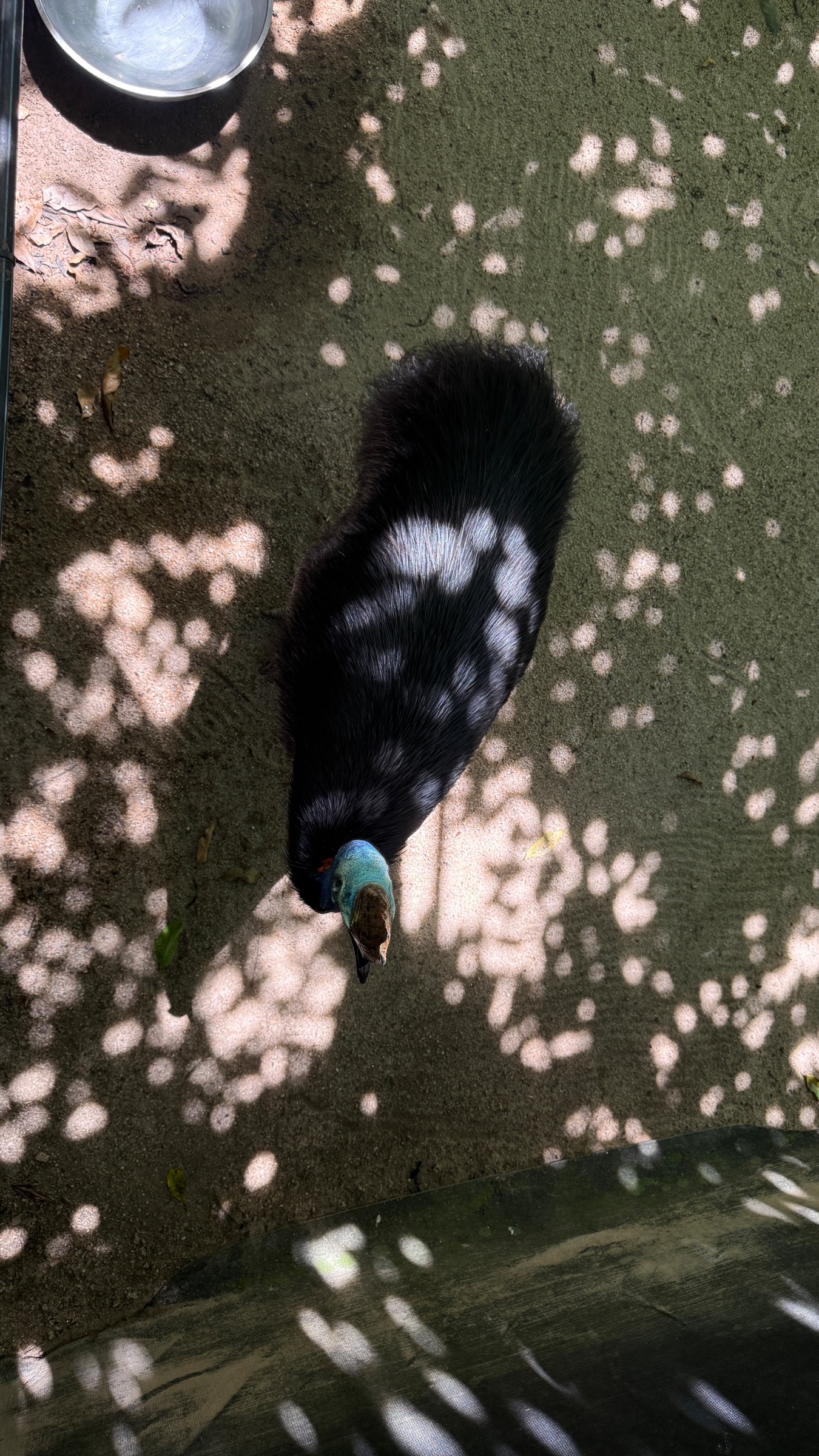
Cassowaries are large, but they can move through dense rainforest. After eating fruit, they carry seeds elsewhere, making them important seed dispersers. After hearing the keeper’s explanation, we looked again at this serious-looking bird with its odd helmet and thought how remarkable the natural world is, with so many creatures shaped for different ways of life.
We also saw tree kangaroos. I had known about kangaroos that hop on the ground, but not ones that live in trees. Their bodies are adapted for climbing, and their long tails help them balance. The ones we saw did not seem interested in posing for visitors. They stayed up in the trees, barely moved, and often turned their backs to us. We waited below for a while but never got a clear look at their faces, so we settled for a few pictures from behind.
The nocturnal house was interesting, too. Dim lighting recreated nighttime, and we looked for possums, snakes and other animals active after dark. Some hid in tree hollows; others curled up on branches and took a moment to spot. Like kangaroos and koalas, Australian possums are marsupials. Their babies are born very small, continue developing in a pouch, and later ride on their mother’s back. Australia’s isolation from other continents millions of years ago left many marsupials to evolve in their own ways: grazing kangaroos, eucalyptus-eating koalas, tree-dwelling possums and carnivorous Tasmanian devils.
The United States has an animal also commonly called a possum, though its formal English name is opossum. Australian possums and American opossums are both marsupials, but they belong to different evolutionary branches. American opossums usually have pointed snouts and nearly hairless tails. Australian possums tend to look rounder and often have furry tails; their big eyes are especially cute.
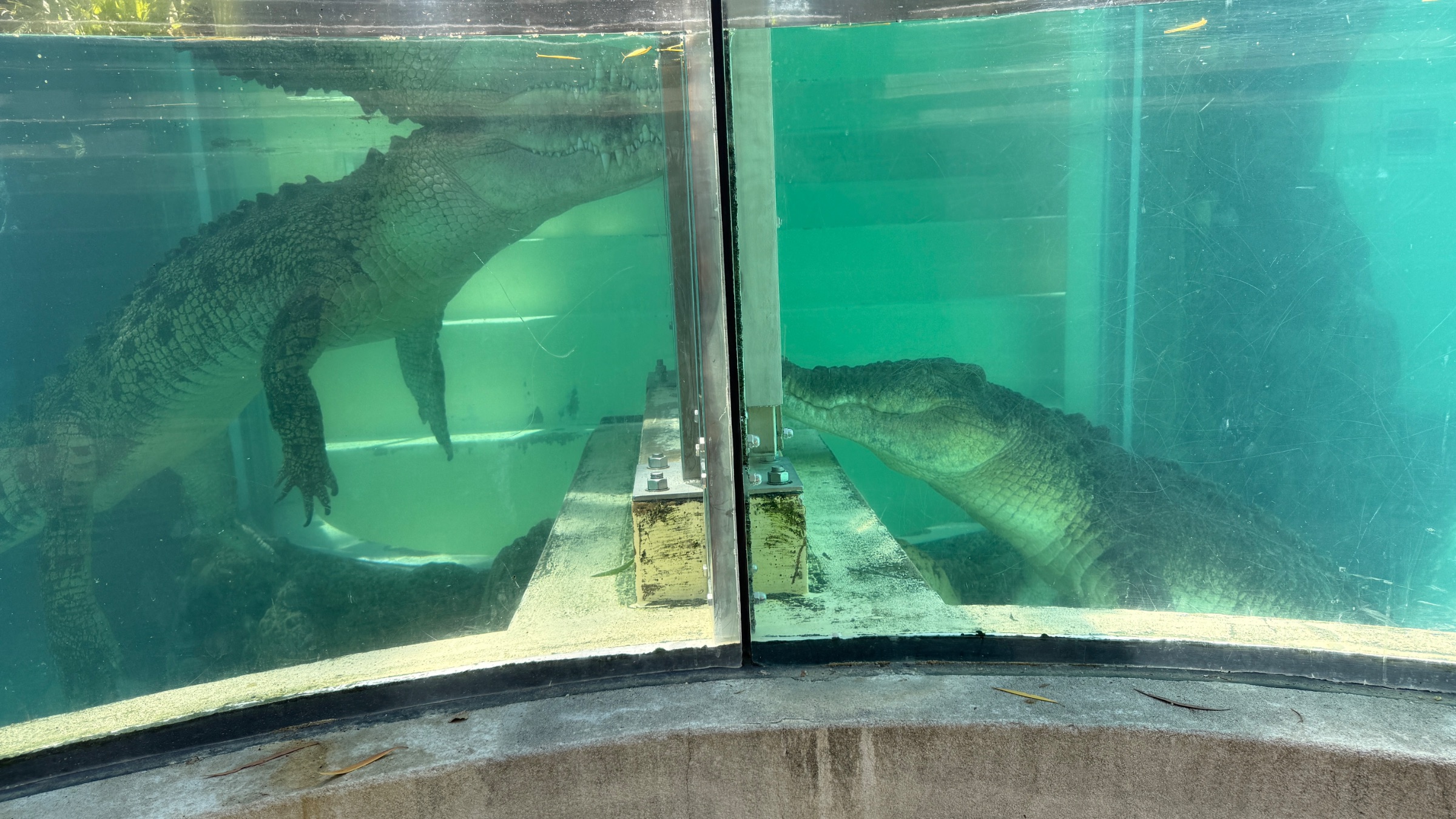
We saw crocodiles as well. At many zoos, you view them from behind a distant fence or see only their heads above the water. Here, a clear panel let us look at them underwater, close enough to make out their huge bodies, rough scales, long snouts and rows of sharp teeth. Two stayed almost motionless in the water. One had its mouth open as if someone had pressed pause. One had obvious teeth, while the other’s mouth looked almost toothless. Crocodiles continually replace their teeth, so missing teeth cannot simply be explained by age. They can also hold their breath underwater for a long time and wait without moving. It was hard to imagine these massive animals suddenly unleashing so much power when they hunt.
Before we knew it, we had spent more than two hours at Wildlife Habitat. We still did not feel ready to leave. We had expected an ordinary Australian zoo, but it turned out to be the biggest surprise of the day.
Four Mile Beach: Tiny Sand Balls on the Shore
After leaving Wildlife Habitat, we drove into Port Douglas for lunch at The Surfy, near Four Mile Beach. The restaurant sits right beside the beach and has a relaxed, casual feel, a little like a seaside place in Hawaii. It was only a little after eleven, and lunch service did not begin until noon, so we walked along the beach first.
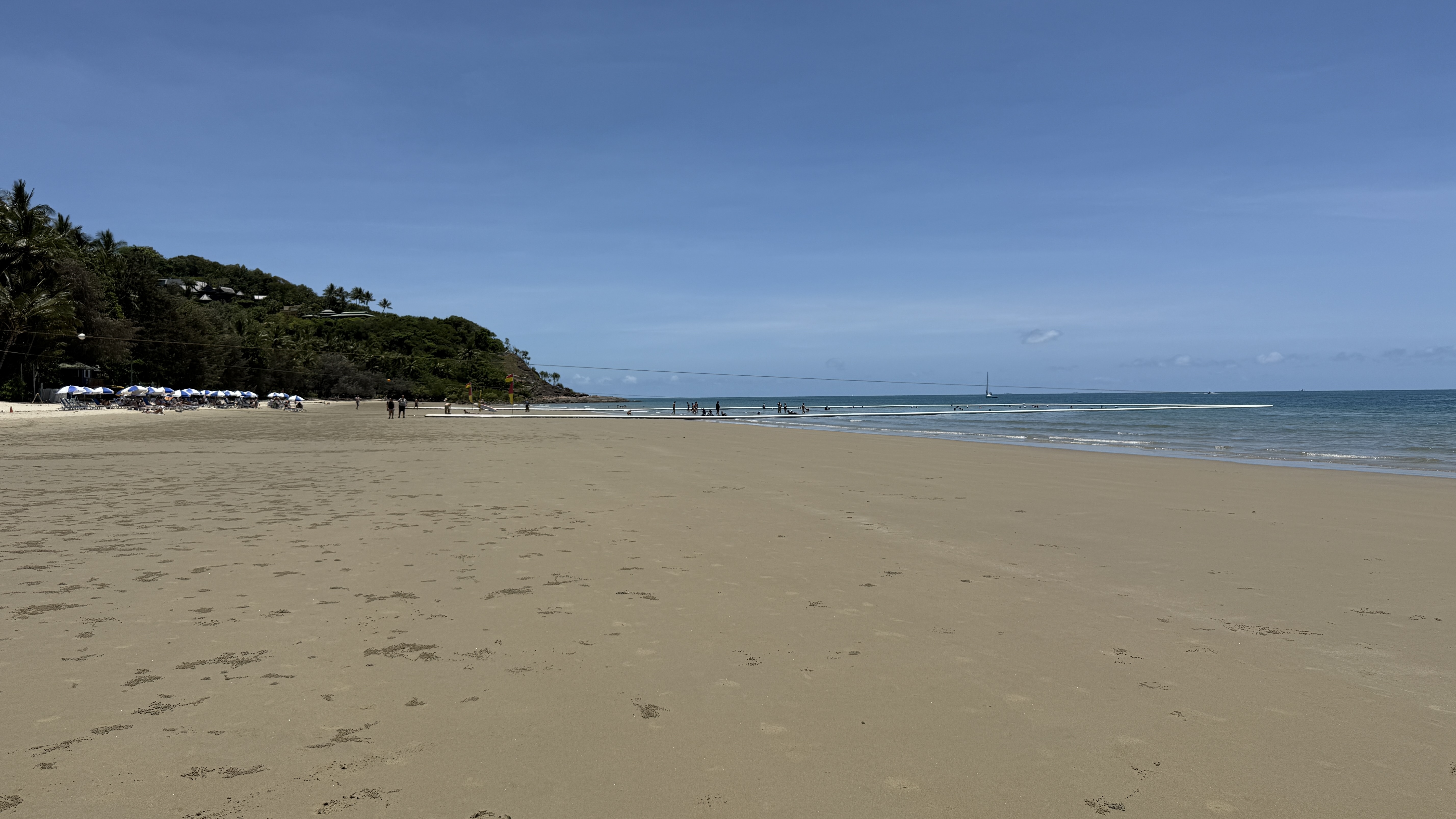
Four Mile Beach is Port Douglas’s best-known beach, with a long, open shoreline stretching south. Despite its name, it is about four kilometers long, not four miles. Seasonal stinger nets along the water are a reminder that this is still the tropics. During stinger season, especially when box jellyfish and Irukandji jellyfish may be around, swimming requires extra care. We only walked and took photos that day; we did not go in the water.
As we walked, we noticed a curious sight: the sand was covered with tiny balls, arranged in little clusters. Some made beautiful radiating patterns.
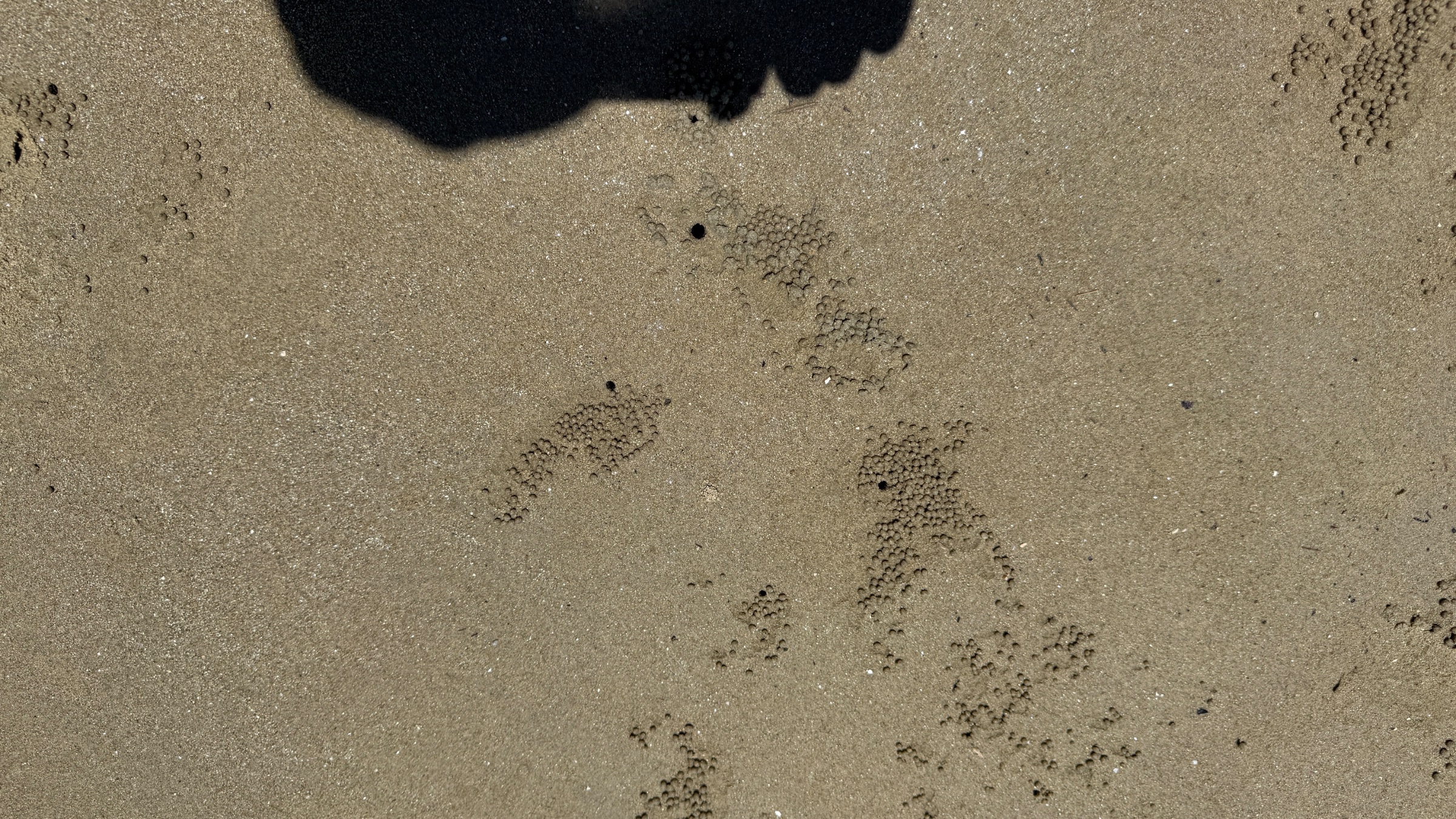
At first we thought they might be traces left by insects. We later learned that they were the work of sand bubbler crabs. At low tide, the tiny crabs come out of their burrows and sift sand through their mouths, picking out microscopic organic matter, algae and other edible particles. Then they roll the processed sand into little balls and leave them nearby. Who knew there was so much food in the sand? We have been to many beaches but had rarely noticed this. We crouched down to look for a while, impressed that these little crabs could decorate so much of the beach with their patterns.
The Surfy: A Seafood Lunch We Loved
At noon, we went back to The Surfy for lunch.
The restaurant was quiet, so we could choose any table. We picked one in the front row by the beach. From there, we could see the sand and blue sea while we ate. The setting was lovely, and the food turned out to be excellent, especially the fresh seafood with its local touches.
We ordered a soft-shell crab taco and barramundi, a well-known Australian fish. The crab was crisp and fragrant, and we ate it shell and all. The taco sauce and vegetables gave it plenty of flavor.
The barramundi came as a large pan-seared fillet, with crisp golden skin and tender flesh. It was served with papaya, mango, cherry tomatoes, leafy greens and coconut-flavored ingredients. The fruit made it sweet and tropical, with a little tang and spice. I usually eat fish steamed, braised or grilled, so pairing it with a tropical fruit salad was new to me. Papaya and mango with fish sounded a little odd, but the combination worked surprisingly well.
For dessert, we tried Feel Good Banana Ice Cream. It is made mostly from frozen bananas, but it was not hard like an ordinary frozen banana. It had the soft, creamy texture of real ice cream and a strong banana flavor. We have tried making frozen bananas at home, but never got anything like this. There must be a trick to it. At least it felt a little healthier than regular ice cream, which made it easier to enjoy.
We were very happy with lunch. The only surprising thing was how few people were there for a Saturday midday. Then we remembered that northern Queensland was heading into its hot, humid rainy season, rather than the cooler, more comfortable months of July and August. Fewer visitors made sense.
Flagstaff Hill: Wild Parrots on the Hilltop
After lunch, we drove to Flagstaff Hill Lookout, one of Port Douglas’s best-known viewpoints over Four Mile Beach. From the top, the coast curved away in a long sweep. We could see the white sand, turquoise water and rainforest-covered hills in the distance. The weather was clear, and the sunlight brought out layers of color in the sea. It was a perfect place for photos.
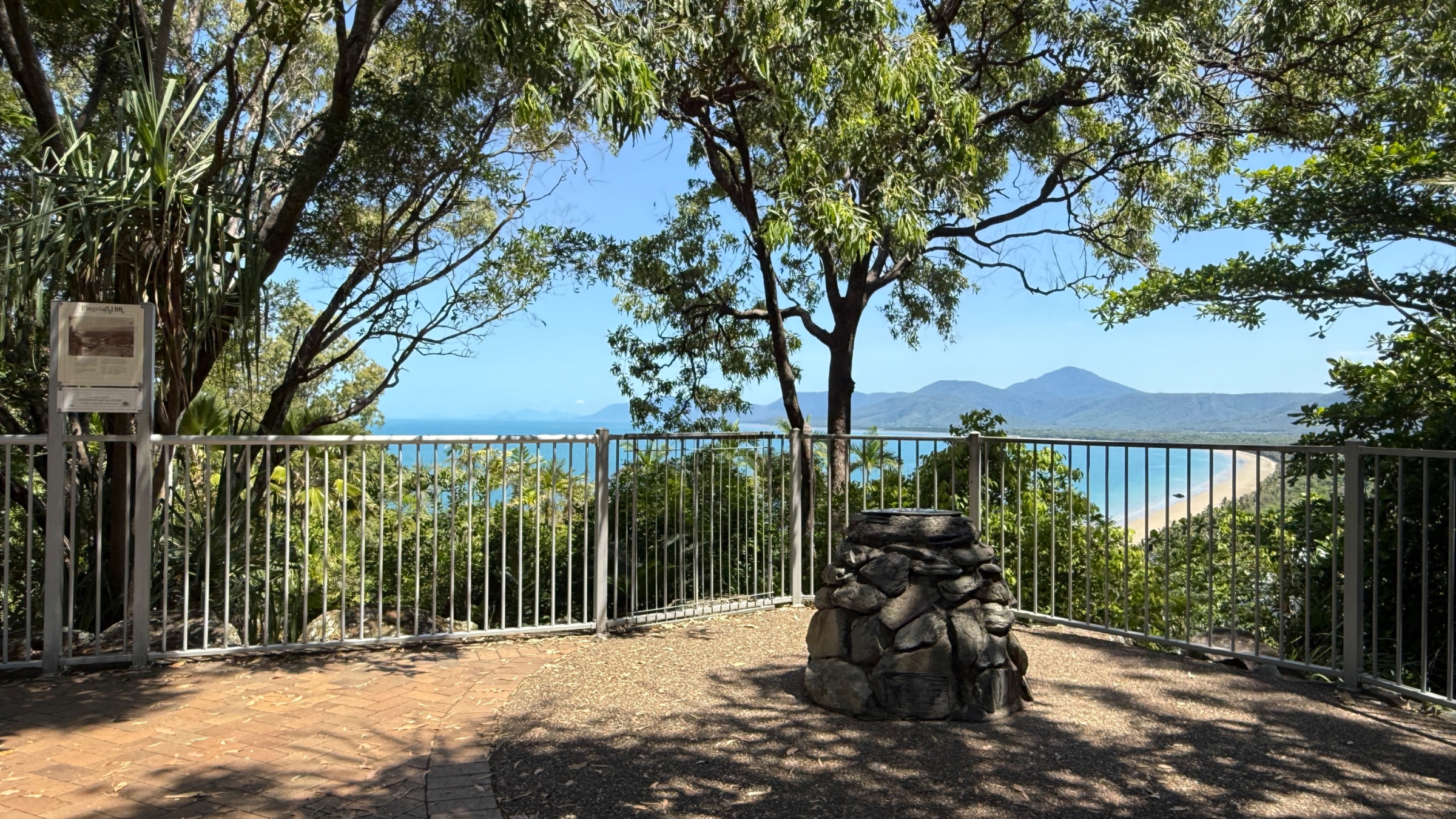
The name Flagstaff Hill has a history behind it. A flagstaff was a pole for signaling with flags. In the nineteenth century, Port Douglas was a busy port in northern Queensland, especially after gold was discovered inland. People and goods passed through the port. Before radio, flags from the hill could tell the harbor when ships were coming and going, which is how the hill got its name. The port is no longer as busy as it once was, but the hill is now a wonderful place for visitors to take in the coast.
What surprised us most at the top was not the view but a few wild parrots in a roadside tree. Their feathers were vivid, with green, red and other bright colors. Some called to one another while others moved among the branches. When a group of visitors walked by, the parrots suddenly grew much louder, calling back and forth as if they were competing to greet everyone. Once the group had left and only the two of us remained, the calls gradually quieted; a few birds stopped altogether. They seemed to enjoy a crowd and being around people.
We had just seen so many parrots at Wildlife Habitat, and then found several more in an ordinary tree outside the park. They really do live in the wild here, not only in zoos or pet shops. For us, coming from the United States, that felt new. In California parks we usually see crows, sparrows, pigeons and squirrels. Here, an everyday roadside tree might hold a few brilliantly colored tropical parrots. We stopped to take more photos; the day was turning into a bird-watching outing.
Saint Mary’s by the Sea: A Little Church by the Water
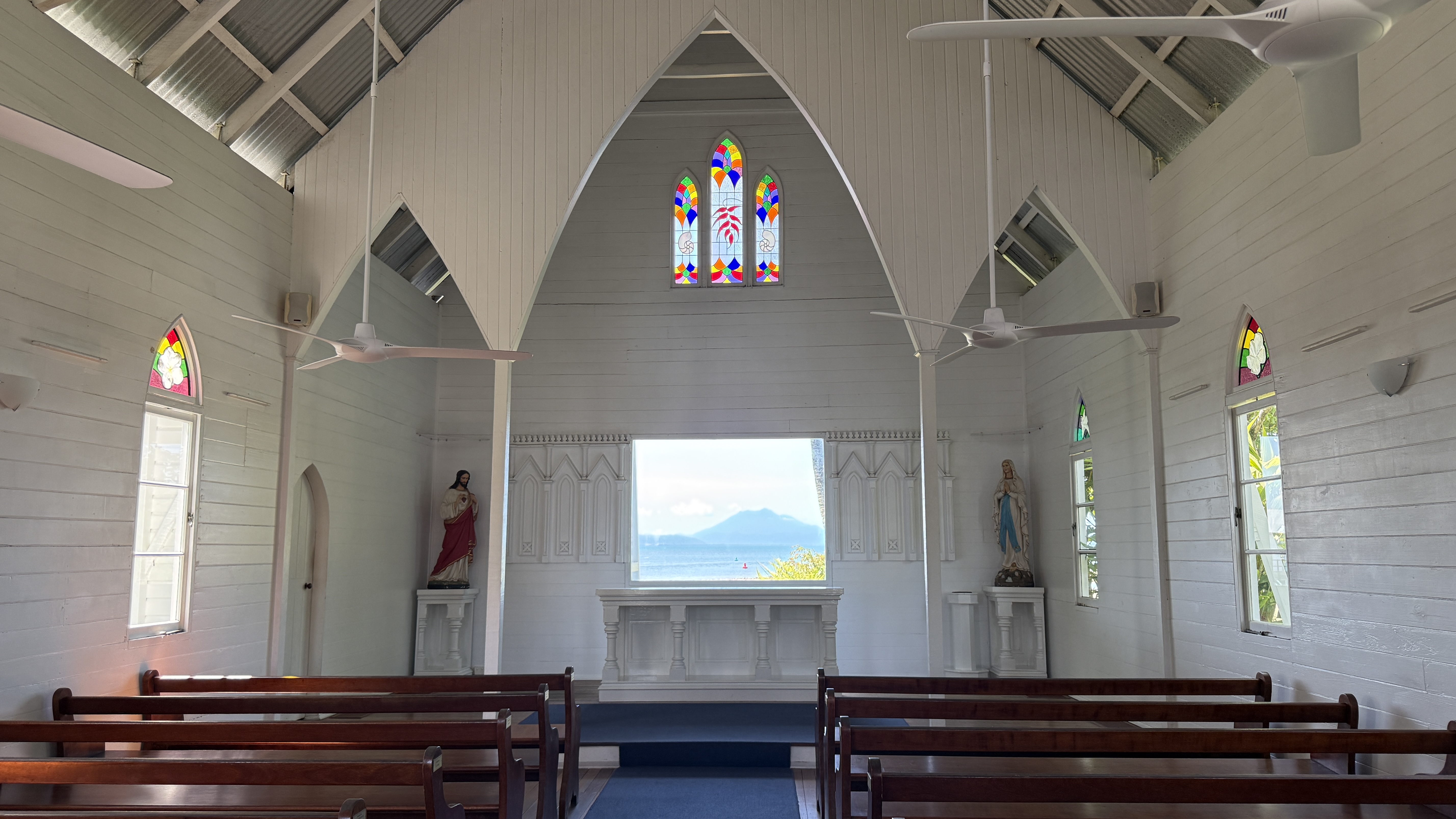
After coming down from the hill, we visited Saint Mary’s by the Sea, a small church beside the ocean. It was a modest white wooden building, with a small cross on the roof, a green lawn, tall tropical trees and the sea behind it. Compared with Europe’s grand cathedrals, it felt simple and charming.
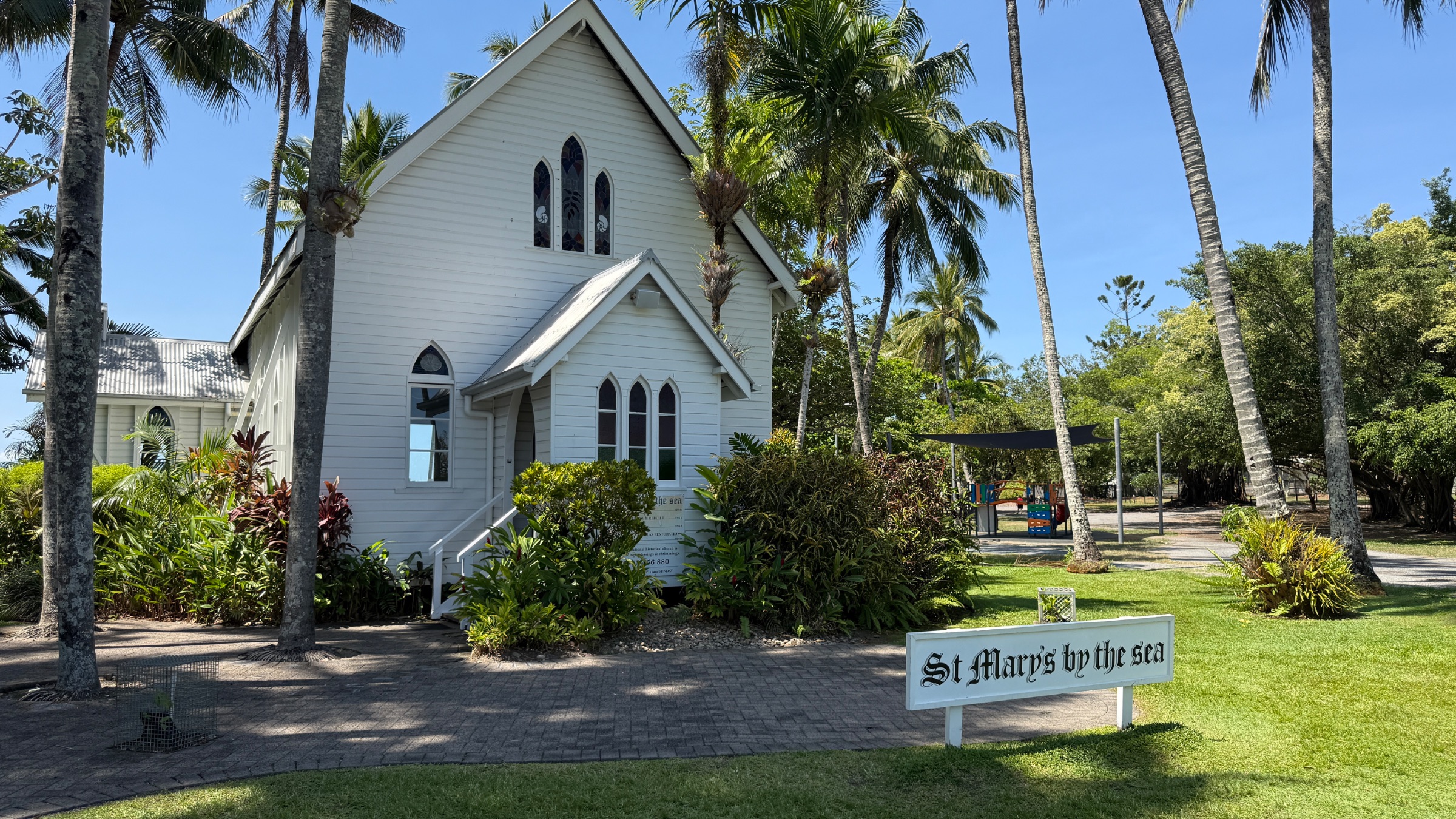
The church has a history of its own. Port Douglas once had a Saint Mary’s church in the late nineteenth century, but it was destroyed in a severe cyclone in 1911. The present church was built in 1914, originally elsewhere in town, and moved to this seaside location in 1988 before being restored. Inside, wooden pews face a large window behind the altar that looks out to the sea. It would be lovely to get married here, with the blue ocean and swaying palms behind the couple.
Coles: Christmas in Short Sleeves
After the church, we stopped at a nearby Coles supermarket to look around and buy some fruit and local specialties. When we travel abroad, I like visiting local supermarkets because they often reveal more about everyday life than souvenir shops. Inside Coles, a large red Christmas sign read “Merry Christmas Port Douglas,” next to advertisements for “Aussie Mangoes in Season” and “Aussie Cherries in Season.” Around us, nearly everyone wore shorts and T-shirts; some people even wore flip-flops. Outside, it was about 30°C in the tropical heat. The contrast was funny.
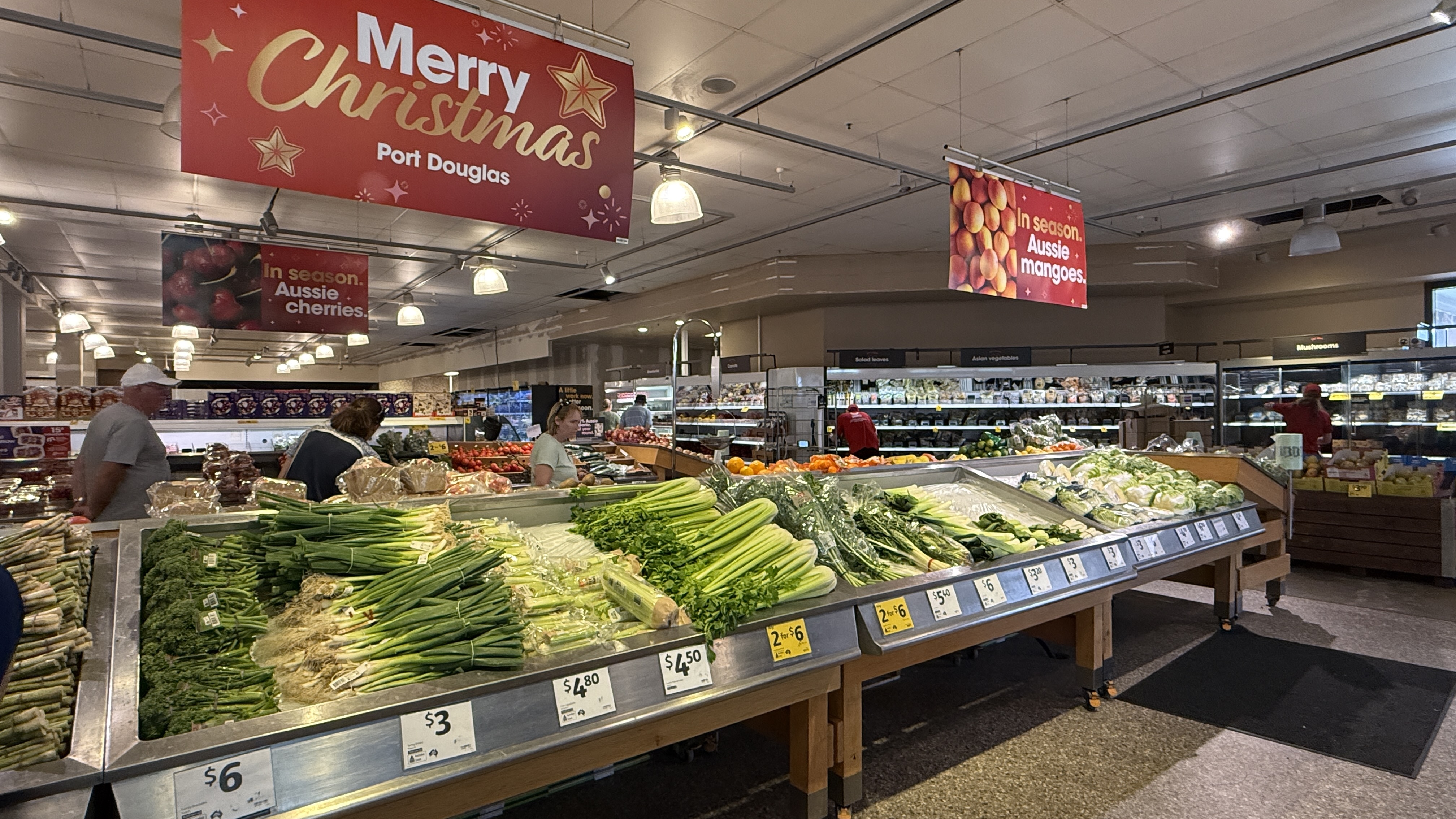
After years in the Northern Hemisphere, we were used to Christmas meaning winter, heavy coats, cold wind and sometimes snow. In Australia, Christmas falls in midsummer. The stores played Christmas music while promoting mangoes and cherries in season. Australian children might spend Christmas swimming, surfing or having a barbecue at the beach instead of building a snowman. It is a completely different kind of holiday.
The Australian mangoes in the supermarket looked especially good: large, bright and tempting. November is the start of mango season here, so the signs made sense. We bought some fruit and local specialties, and looked for Australian treats we could bring back to friends in the United States. That brought our day to an end. We drove back along Captain Cook Highway to Palm Cove and reached our resort shortly after four.
Tomorrow will be a very different day. We have booked a trip out to the Great Barrier Reef with Reef Magic. We hope to see sea turtles and colorful reef fish.
Reader Discussion · 0
No comments yet. Be the first to share your experience.