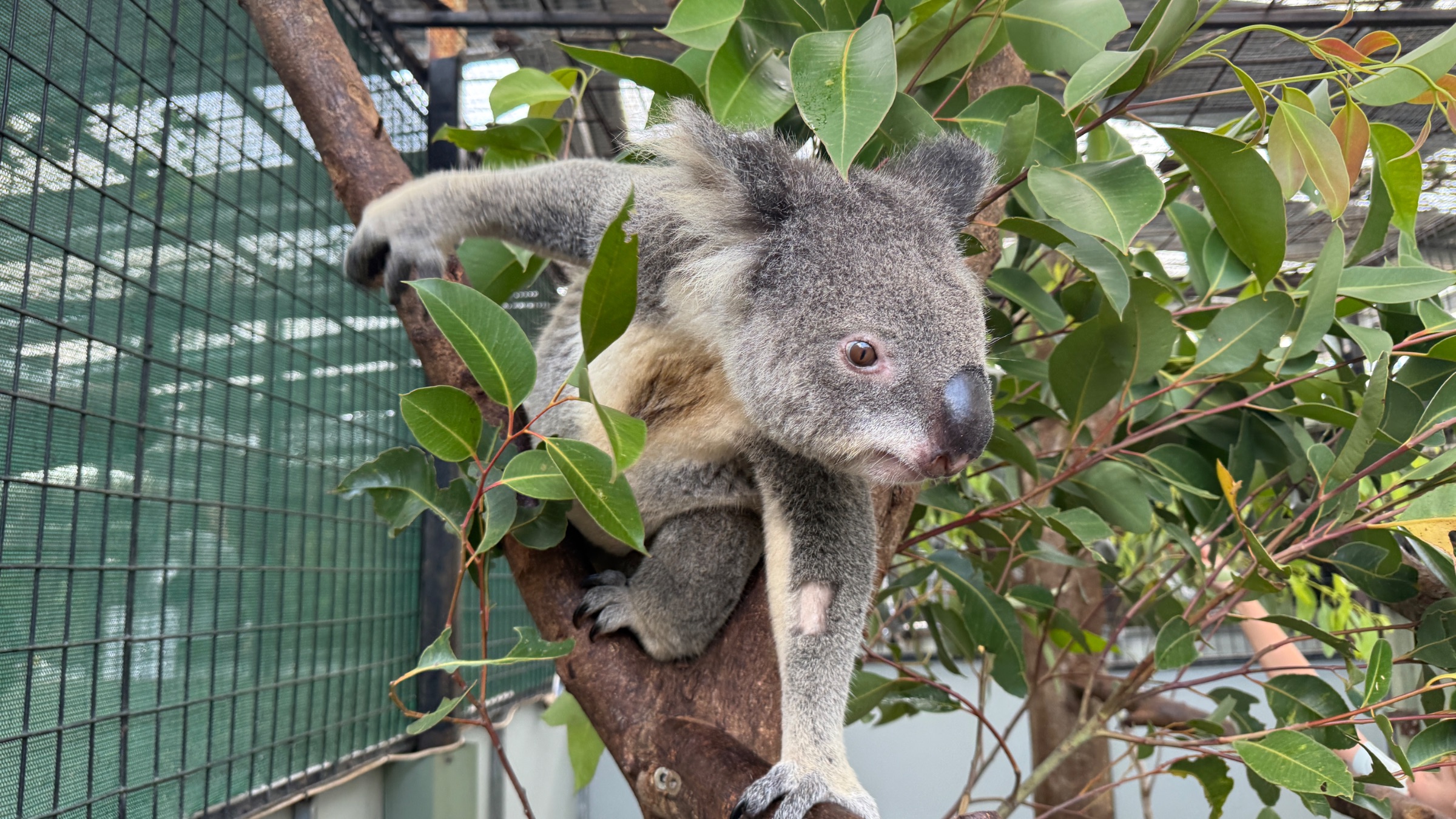
These days in Australia, we have been going to bed around six or seven in the evening and waking naturally around four or five in the morning. We have also been sleeping remarkably well. This morning, while I was on a family video call with our eldest son, I glanced down from our fourth-floor balcony and spotted two kangaroos on the lawn behind the apartment. I grabbed my phone and took a few pictures. They grazed peacefully, then hopped away. We later learned they were agile wallabies, a smaller species common in northern Australia. The lawns and tropical trees around Coral Coast Resort make a good habitat for them. Just a few days earlier we had paid to see kangaroos at a wildlife park; now they were coming to breakfast for free right below our balcony.
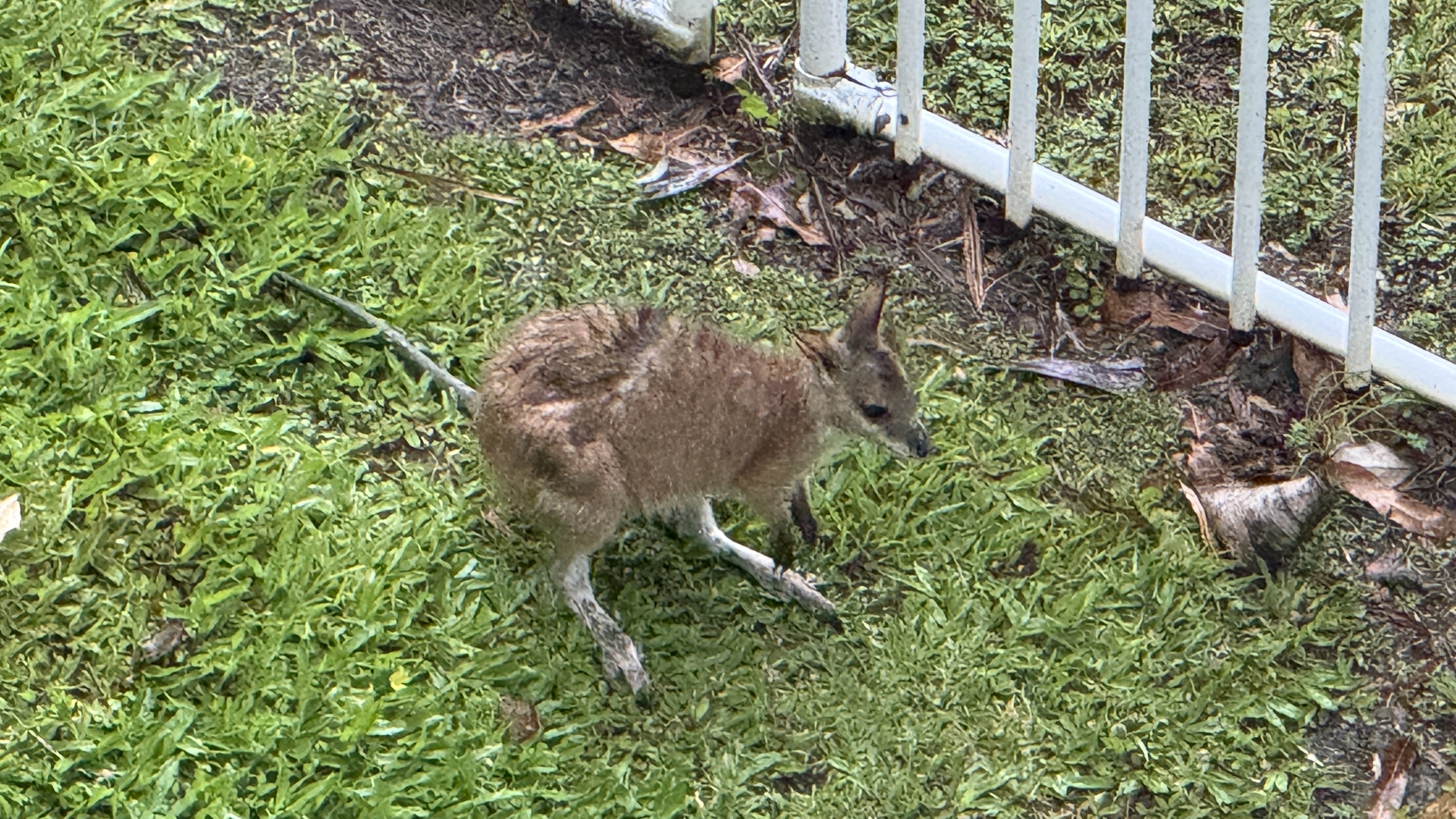
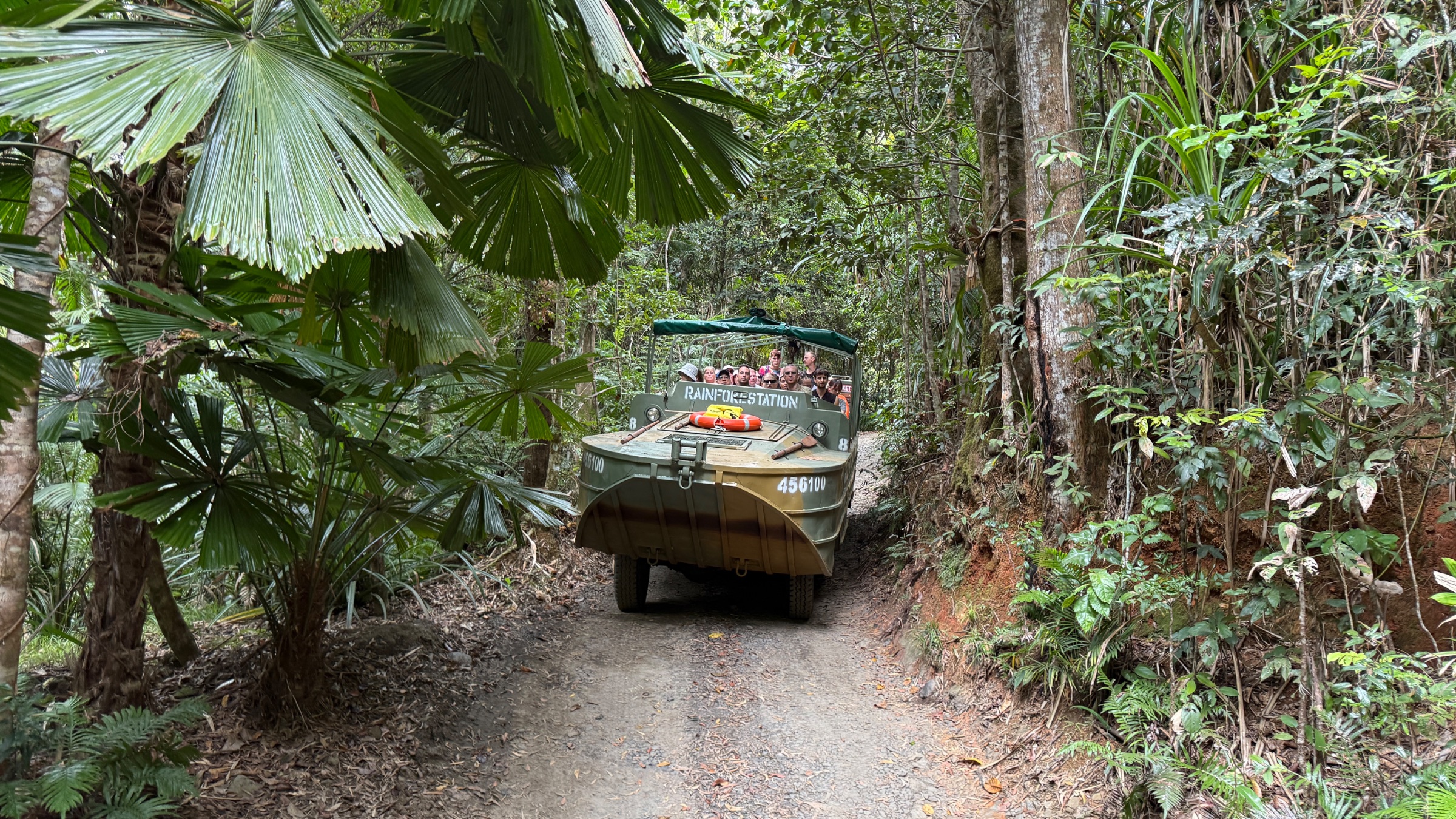
We had planned to visit the Kuranda rainforest today. We had booked a koala encounter in advance and intended to upgrade our tickets on arrival so we could also ride a World War II amphibious vehicle and learn about Aboriginal culture. We left at 8:30, stopping in Smithfield so my wife could get a local SIM card. It normally cost A$44, but a Black Friday deal brought it down to A$13 for 65 GB—more data than we would need before returning to the United States. Then we drove up the winding road to Rainforestation, upgraded our tickets, and began the rainforest adventure. A staff member told us the next Army Duck was at ten. It was already 9:55, so we hurried to Platform 2. The line had formed, but the vehicle had not arrived yet. After five or six minutes, we climbed aboard the old-looking military truck. Our guide wore camouflage and a military cap, and kept us entertained while pointing out rainforest plants along the way.
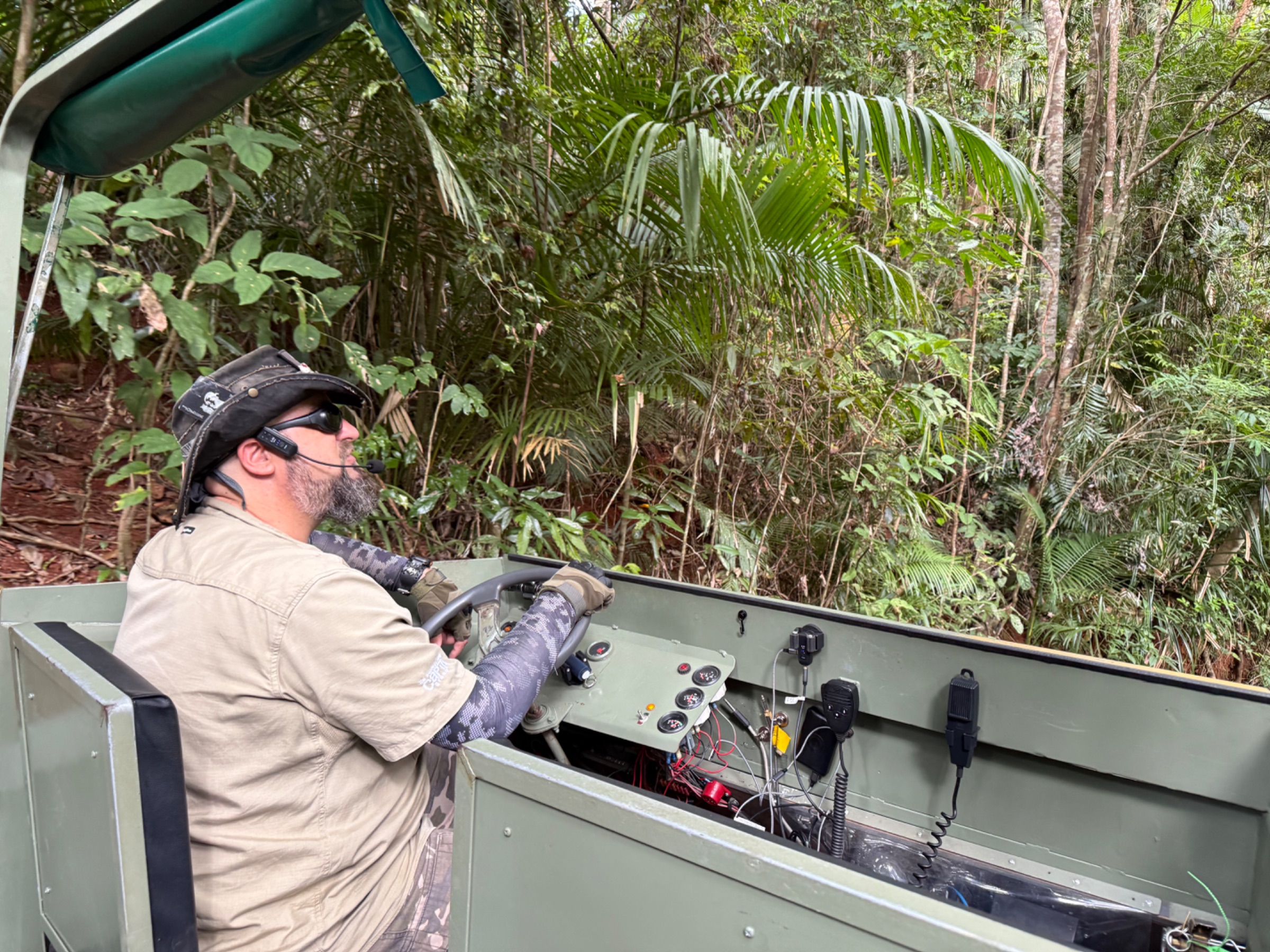
This is part of the Wet Tropics World Heritage Area, and the plant life is remarkably diverse. Our guide warned us not to touch a heart-shaped leaf called Gympie-Gympie, or the stinging tree. Its surface is covered in tiny hairs that can pierce the skin and release toxins, causing intense pain. He described it as feeling like countless tiny shards of glass in your skin, with the pain sometimes lingering or flaring up again when the area gets wet or changes temperature. It sounded terrifying. The leaf looked so green and ordinary, yet it could cause that much pain. Australia has venomous snakes and spiders, and apparently even the leaves can be dangerous. We decided not to touch anything in the rainforest.
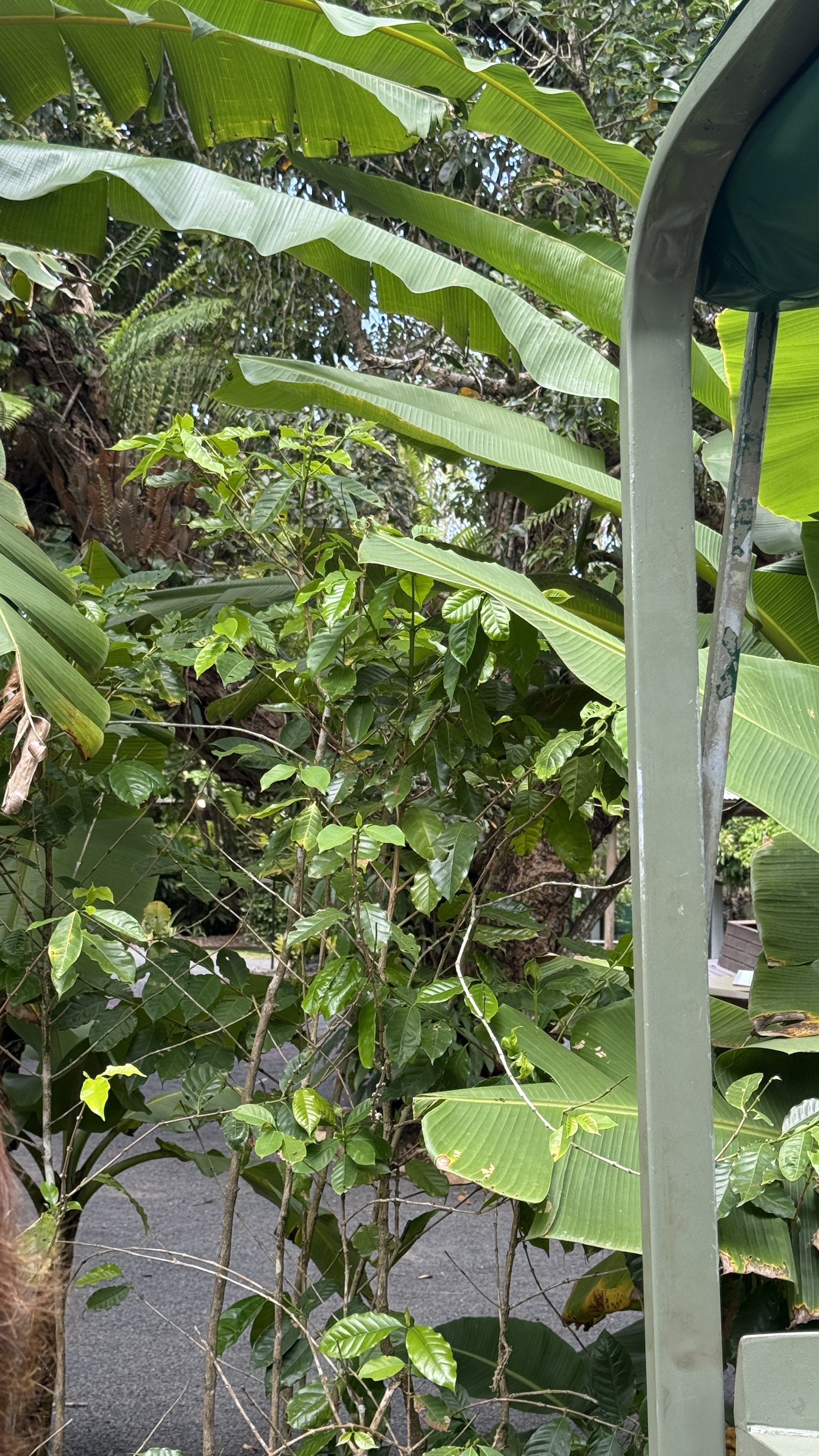
Our guide also pointed out banana trees, coffee plants, and other tropical species. Some trees had strange growths, and other plants were growing directly on top of them. The forest was full of plants twining around and depending on one another. A fallen tree trunk had been hollowed out in the middle; the guide said termites had done it. We deal with termites in California, but as household pests. I had never seen them hollow out a tree that thick in the rainforest. Wherever you find them, termites clearly work hard.
At one point we came to a fork in the path. The guide said one route went uphill and the other led into the river, then asked everyone to vote. Naturally, we all wanted the river. He warned us, very seriously, that the route was dangerous and we should prepare ourselves. The vehicle kept moving—and drove straight into the water! The Army Duck is amphibious. Once it entered the river, the wheels stopped providing propulsion and a rear propeller took over, with a rudder steering us. One moment it was a truck; the next, it was a boat.
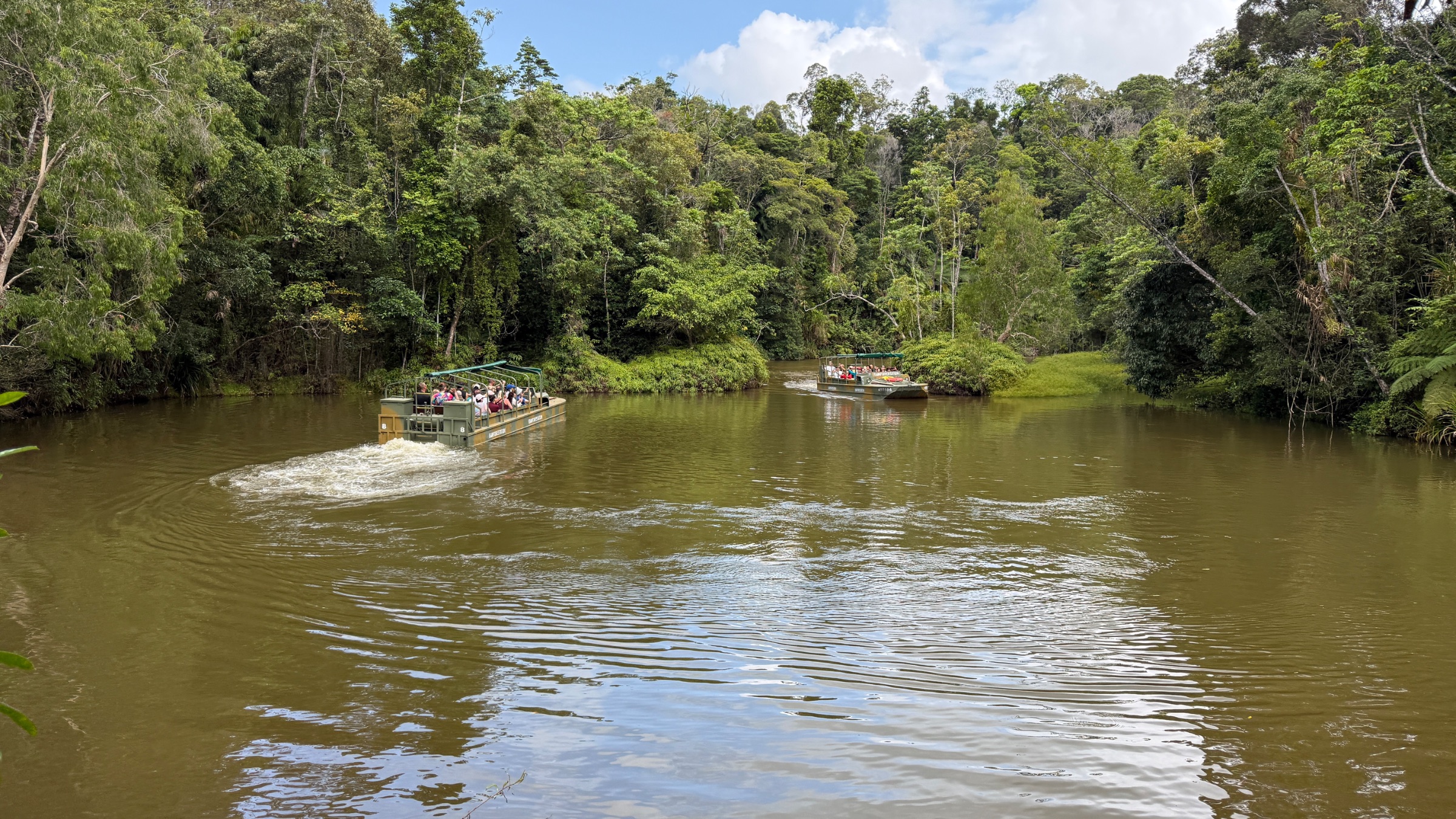
The vehicle is officially called a DUKW, a six-wheel-drive amphibious transport developed in the United States during World War II. It carried troops and supplies from ships to shore, especially where there was no port. Based on a GMC military truck, more than 20,000 were built between 1942 and 1945. They served in the Pacific, Sicily, and the Normandy landings. The manufacturer, Yellow Truck and Coach, was part of General Motors and had experience building buses, which explains our guide’s comment about a connection to American school buses.
The DUKW could reach about 80 kilometers per hour on land, but only around 10 kilometers per hour in the water. Even more surprising, some are still in service more than 80 years later. Rainforestation has used Army Ducks since the 1970s, has more than ten of them, and employs a mechanic to maintain the fleet. We had ridden a Duck Tour in Boston before, another amphibious vehicle that drives through the city and into the Charles River to show visitors landmarks and historic buildings. This was completely different: our vehicle rumbled through dense rainforest while the guide talked about the plants, then suddenly drove into the water. It felt more like an adventure than a city tour. The stretch on the river was not long, but the guide was funny and the half hour went by quickly. Eighty years ago these vehicles carried soldiers toward a battlefield; now they take tourists on a rainforest outing. That is a much nicer assignment.
After the Army Duck ride, we hurried to the 11:00 Koala Photo experience. We had checked the photo area around 10:40 and, seeing no one there, waited a few minutes before wandering nearby. When we came back, a long line had formed, mostly a Chinese tour group with a few other visitors. We joined the end of it and wondered how long we would be waiting.
When it was our turn, the staff asked us to cross our arms over our stomachs, then placed a koala on our arms. The koala cooperated, wrapping its front paws around us while the staff took the photo. My wife held it first while I gave it a quick pat, then we switched. It had a distinctive smell, a little like eucalyptus leaves. The koala looked gentle and moved slowly; holding it felt surprisingly comfortable.
The whole thing was over almost immediately. Each person held the koala for a few seconds, the staff took a picture, and then it was passed to the next visitor. It felt like an assembly line. The staff explained that Queensland strictly limits koala interactions. Each koala can participate for only about half an hour a day and must have regular days off. Koalas sleep 18 to 22 hours a day, after all. The rules made sense, but after waiting in line, a few seconds with the koala felt a little disappointing.
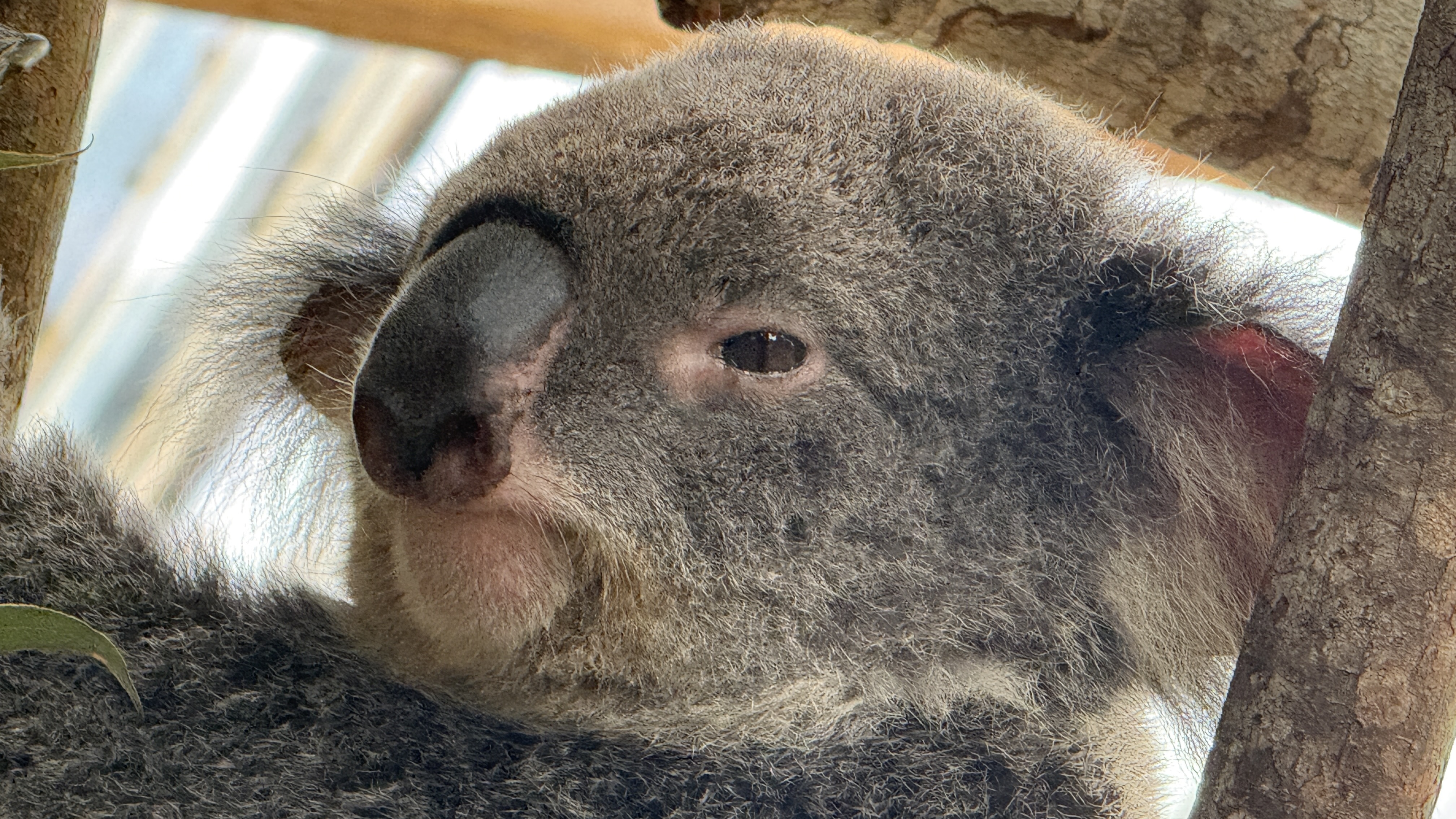
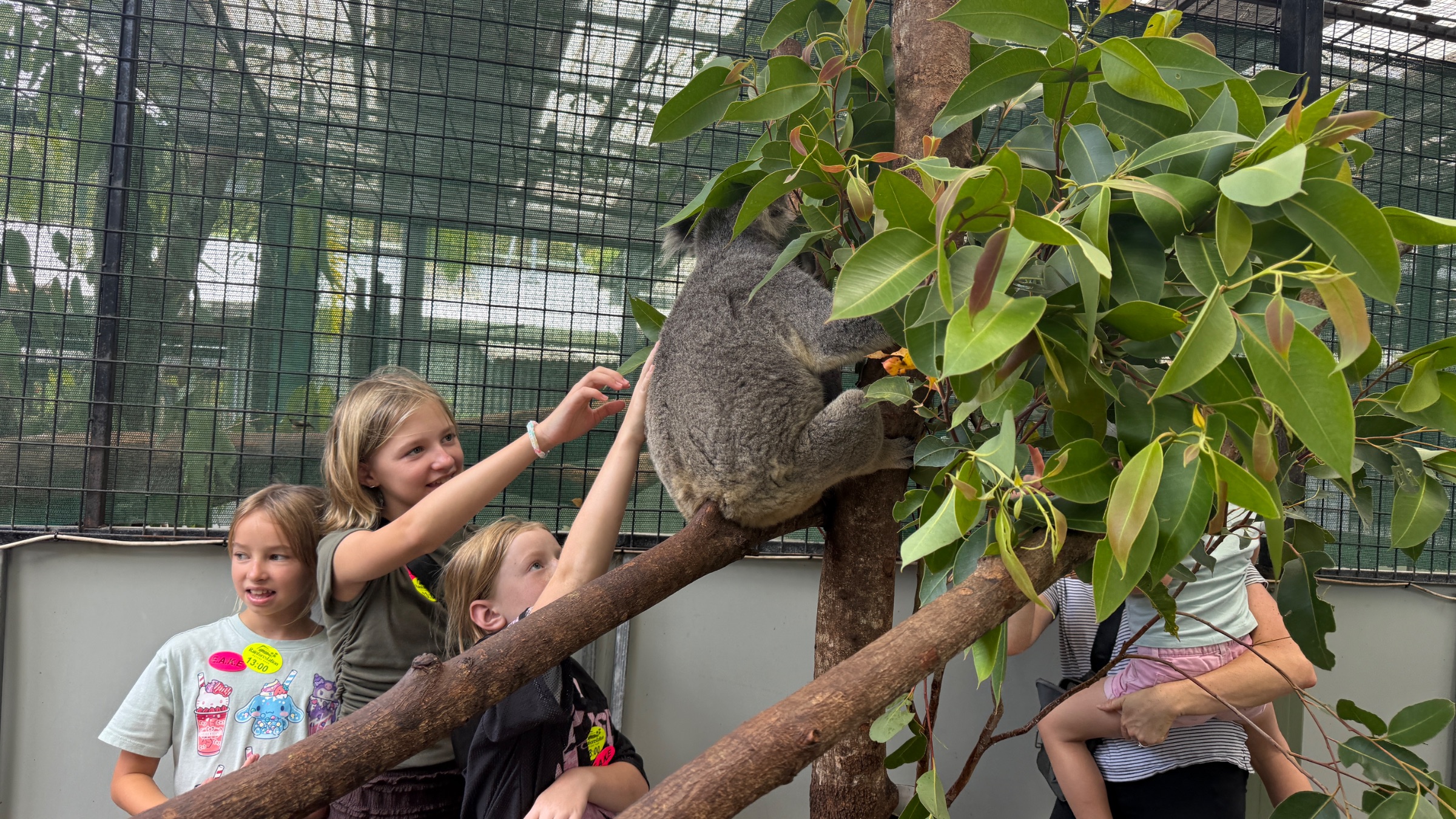
Fortunately, we had also booked the 11:30 Exclusive Access Koala Experience, which was completely different. There were very few people—just us and one other family, with no tour group. A keeper took us into the koalas’ living area and explained their habits up close. We could ask questions, take photos, and, with permission, gently touch them. The session was scheduled for half an hour but ran longer.
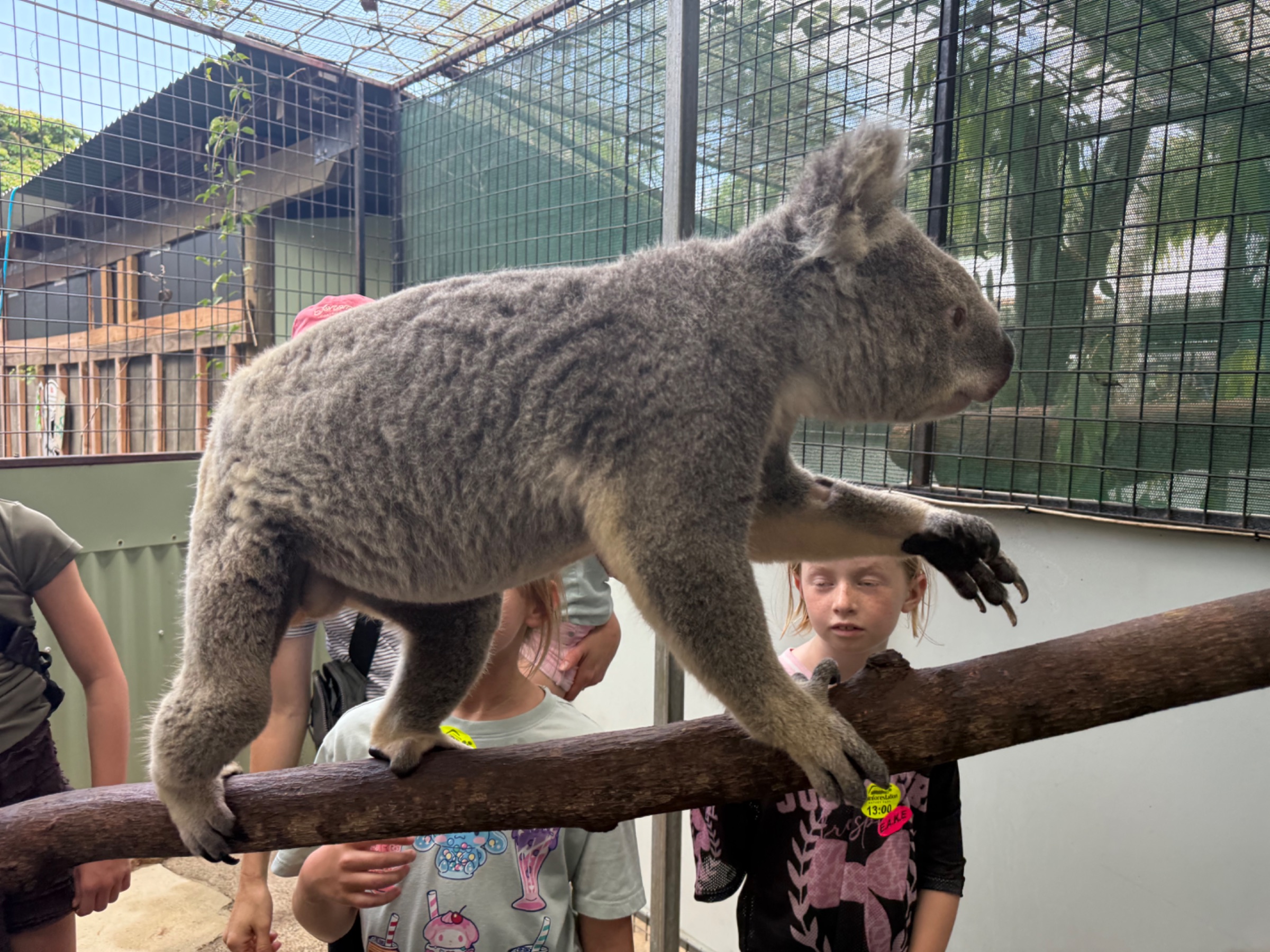
The park had several koalas of different ages and sizes. We spent most of our time with the oldest and largest one. It was very calm, resting slowly along a branch and barely moving. The keeper let us touch its back, head, and ears, and it did not seem to mind. When we touched its paws, it sometimes pulled them away and sometimes let us continue; it depended on its mood. Its fur felt thick, not quite like the plush toy I had imagined.
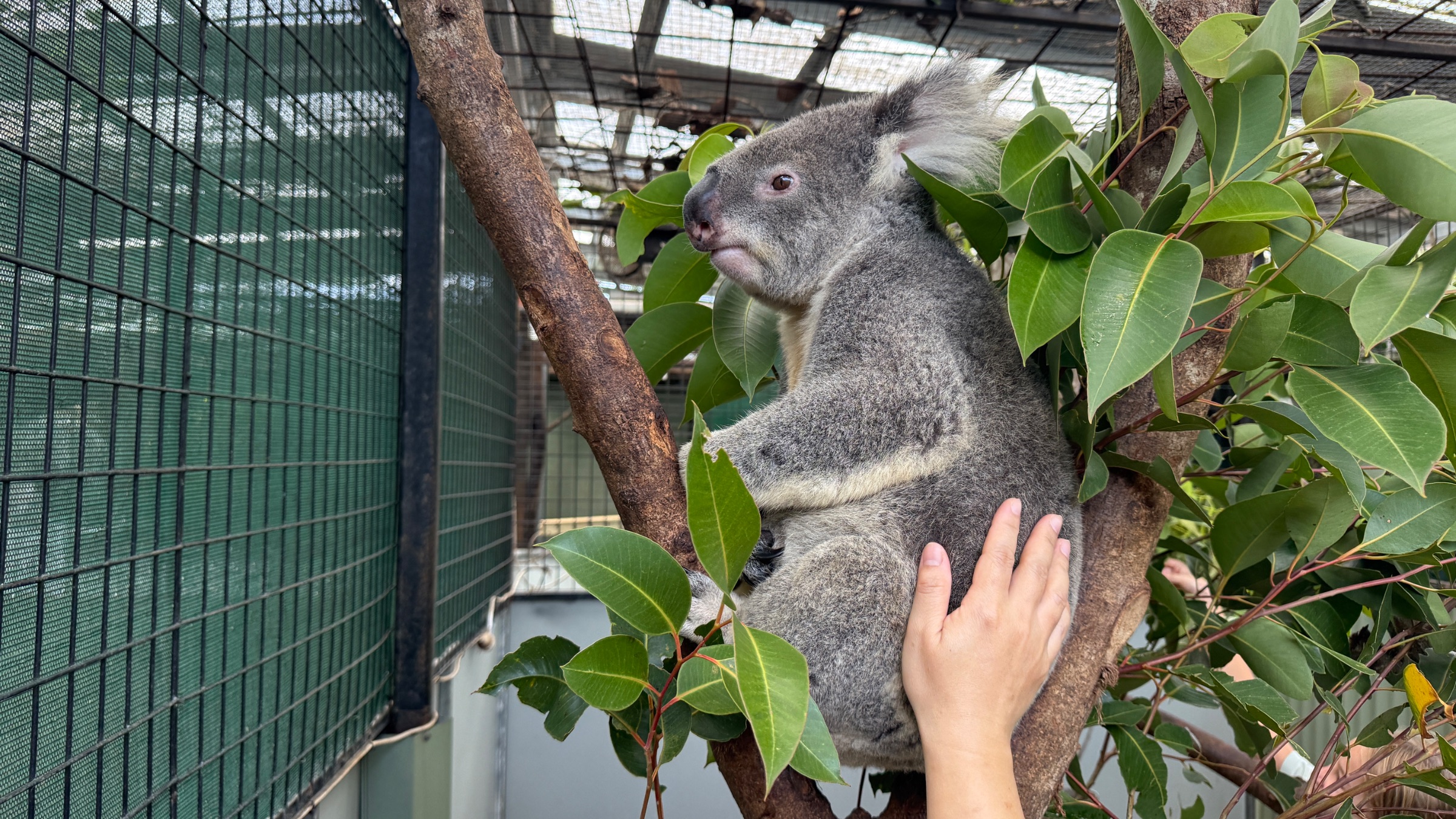
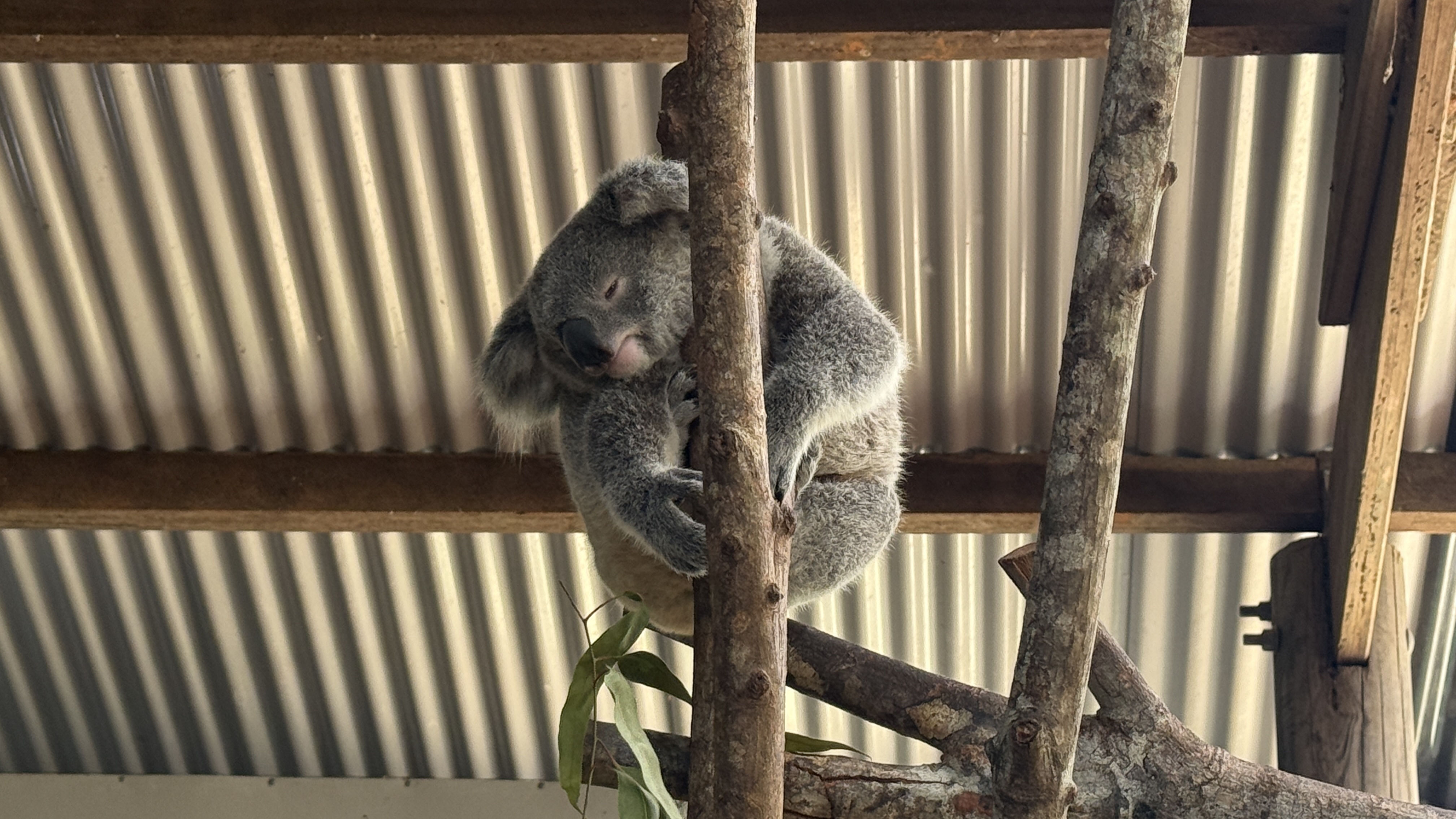
Nearby, another koala was asleep at the top of a tree, its whole body draped over a branch without moving. I asked the keeper whether koalas ever fall out of trees. Usually they do not, he said, though it happens occasionally. Their skulls are fairly sturdy and can handle some impact, but a fall from high up could still injure them.
Koalas mainly eat eucalyptus leaves. The leaves are low in nutrients and contain chemicals that are toxic to many other animals, so koalas need a specialized digestive system to process them and conserve energy. No wonder they move so slowly and take sleep so seriously. At other zoos, we had mostly seen koalas sleeping from a distance. Being able to observe one so closely and talk with a keeper for more than half an hour was a rare treat.
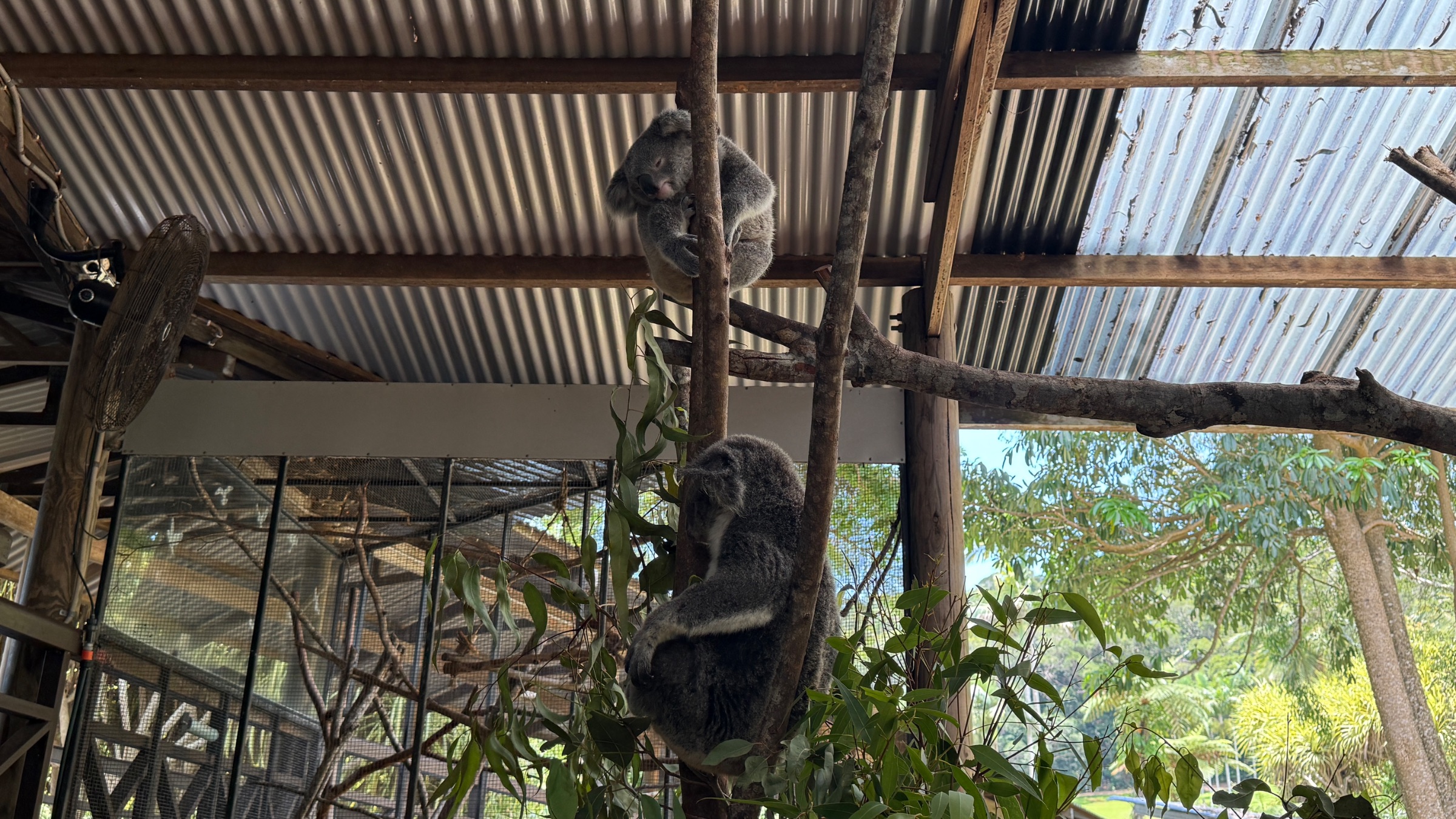
Between the two experiences, I thought the Koala Experience was far more worthwhile than the Koala Photo. The longer visit gave us time to observe the koalas, gently touch them, learn about their habits, and take our own pictures. The photo session let us hold one, but only for a few seconds, and felt overly commercial. If friends visit, I would recommend the Koala Experience. The photo session is easy to skip unless holding a koala for a picture is especially important to you.
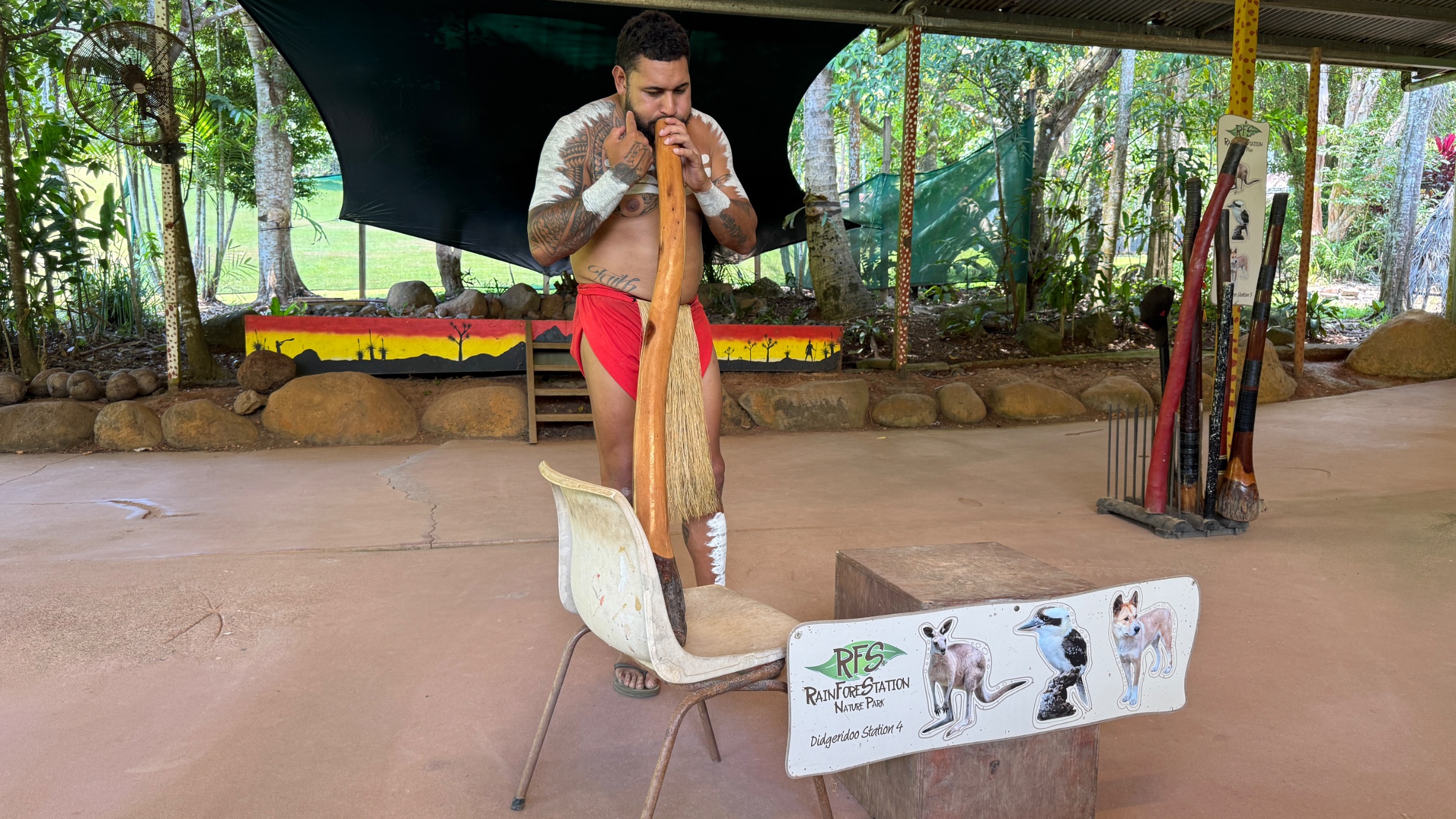
Next we watched the Pamagirri Aboriginal Dance Performance in an outdoor theater surrounded by tall tropical trees. The performers used a didgeridoo, a long tubular instrument that makes a low, continuous drone, along with clapsticks to keep the rhythm. Their dances depicted animals and traditional life. One dance imitated a snake moving quietly; Pamagirri itself means “quiet snake.” Other dances portrayed cassowaries, kangaroos, and hunting and gathering. These performances are not simply for entertainment: movement and music tell stories and carry knowledge from one generation to the next.
We had seen Māori cultural performances in New Zealand and similar Indigenous cultural experiences in Hawaii and Taiwan, so the format was familiar. Australian Aboriginal music and dance still had a character of its own. The deep, resonant sound of the didgeridoo was especially memorable.
After the dance, we joined the Dreamtime Walk. “Dreamtime” is not simply a period of dreaming; it refers to a body of Aboriginal traditions and stories about ancestors, the origins of the world, the land, and the relationship between people and nature. Different regions and communities have their own stories, so it should not be treated as one uniform religion. The Kuranda area where Rainforestation is located is traditionally Djabugay country. In the Pamagirri experience, local Aboriginal guides introduce visitors to traditional instruments, hunting tools, and practical skills.
There were far fewer people on the Dreamtime Walk than at the dance. We wondered where the tour groups had gone. We found this part more interesting than simply watching a performance because we could listen up close and try things ourselves. Maybe many visitors feel they have learned enough after the dance, without realizing there is more to discover.
The first instrument the guide introduced was the didgeridoo. It is usually made from a long wooden tube; one traditional method is to find a eucalyptus tree trunk hollowed out by termites, then shape it into an instrument. Players vibrate their lips to produce the sound, and skilled musicians use circular breathing to keep it going continuously. Our guide demonstrated several sounds, some of which resembled animal calls. We have seen many traditional instruments, but it was impressive how much variety one wooden tube could produce.
Next came spear throwing. I had always imagined Aboriginal people simply throwing spears by hand. Today I learned about the woomera, a long throwing stick with a small hook at the end that fits into a notch in the back of the spear. It extends the arm and acts as a lever, helping the spear travel faster and farther. The guide demonstrated, and the spear flew a long way—much farther than I could have thrown it by hand. People thousands of years ago already understood how to apply this mechanical advantage to hunting. They may not have written down modern engineering formulas, but they knew how to put the principles to work.
The boomerang was what I had been most curious about. I had seen them in shops but had never tried one or learned whether they really came back. The guide showed us the grip and angle. Instead of throwing it flat like a frisbee, we had to hold it upright, tilt it slightly, and aim around the one o’clock direction. It also needed a fast spin to follow a curve and return.
Each of us got two tries. It was easier than I expected: most people managed to send the boomerang along an arc, and some came back close to where they started. We noticed that a low throw could rise as it traveled, while aiming too high from the start did not work as well. A boomerang’s flight is not an ordinary parabolic arc; its rotation creates aerodynamic lift and gyroscopic effects that change its direction. I had thought of the boomerang as a magical movie prop, but it turns out I could throw one reasonably well—though I could not guarantee it would come back to my hand.
Not every Aboriginal boomerang is designed to return. Some traditional boomerangs were made for hunting or other purposes and did not come back after being thrown. The returning kind requires a particular shape and technique; that was the type we tried today.
After giving it a try, I enjoyed it so much that I bought one in the gift shop to take home for our children. The one they sold was painted by the Aboriginal staff member who had just taught us to throw it, and his father had made the wooden piece. That gave it more meaning than an ordinary souvenir: we knew who made it and had watched him use it. I just hope the kids can get it to come back instead of having to retrieve it from a neighbor’s yard.
We had seen Māori performances in New Zealand, where the haka, songs, carvings, and canoe traditions stayed with us most. In Hawaii, we saw more hula and Polynesian navigation traditions. Indigenous cultural presentations in Taiwan include songs, weaving, and hunting tools, though practices vary greatly from one community to another. Aboriginal culture in Australia is equally diverse; hundreds of distinct groups across the continent have their own languages and traditions. The didgeridoo, woomera, and returning boomerang we experienced in Kuranda offered a different perspective from those earlier visits. Trying the boomerang ourselves made the difference between watching and participating especially clear.
Overall, I thought all three main activities at Rainforestation were worth doing. The Army Duck ride was not just a trip in an old military vehicle; it also covered rainforest plants and the vehicle’s World War II history. The Koala Experience gave us much more time with the koalas than the quick photo session. The Pamagirri Dreamtime Walk taught us things and let us try the boomerang ourselves. The most popular activities—the koala photo and dance performance—were not, in my view, the most rewarding. I was glad we upgraded to the Big Nature Package that morning, or we would have missed two of the best experiences.
We left Rainforestation after lunch time and drove back to Smithfield Shopping Centre for a meal at Sushi Train, a Japanese conveyor-belt sushi restaurant. It had plenty of choices and was inexpensive. We took only four plates between us, and the bill came to just A$19. The portions were generous—one plate of tuna sushi had several pieces, and by the end we were nearly too full to finish. The food was fairly ordinary compared with sushi we have eaten in Japan and the United States, and I found it too salty. Still, A$19 for lunch for two in Australia was a bargain. The price had the spirit of an affordable sushi train, even if the flavor was not quite there.
We walked around the shopping center afterward. Black Friday and Christmas promotions had already started, and we wanted to bring something distinctly Australian home for friends. We picked up some native herbal teas from XO Tea. One blend, Native Cleanse, included lemon myrtle, river mint, and strawberry gum, plants native to Australia. The package said the ingredients came from Indigenous wild-harvesting cooperatives and native-plant farms. Aboriginal people have gathered and used these plants for thousands of years; turning them into modern herbal tea is one way that tradition continues in everyday life.

Back at our apartment in Palm Cove, we ate dinner and went downstairs for a walk before it was completely dark. The agile wallabies we had seen that morning were back. This time there were three of them—one large and two smaller ones—grazing together like a family. They seemed used to the apartments and people nearby. After eating for a while, they hopped off toward the trees. This lawn seemed to be their regular restaurant, open for breakfast and dinner, with a free buffet.
We also ran into the unusual bird we had seen several times in the parking lot: a bush stone-curlew. It has long, slender legs and round, prominent eyes, and a very distinctive walk. We had seen it several times but never watched it fly. It usually strode quickly across the ground, then stopped and stared around like a security guard on patrol. It can fly, but it spends more time on the ground and is a fast runner. At night, it makes a strange call that sounds almost like someone crying out. Maybe those enormous eyes are for the night shift.
We had spotted two wallabies from our fourth-floor balcony in the morning, then three while walking in the evening, along with the bird that patrols the parking lot every day. Our resort apartment came with a pool and tropical gardens—and, apparently, a free wildlife park where the animals show up for work on their own schedule.
Reader Discussion · 0
No comments yet. Be the first to share your experience.